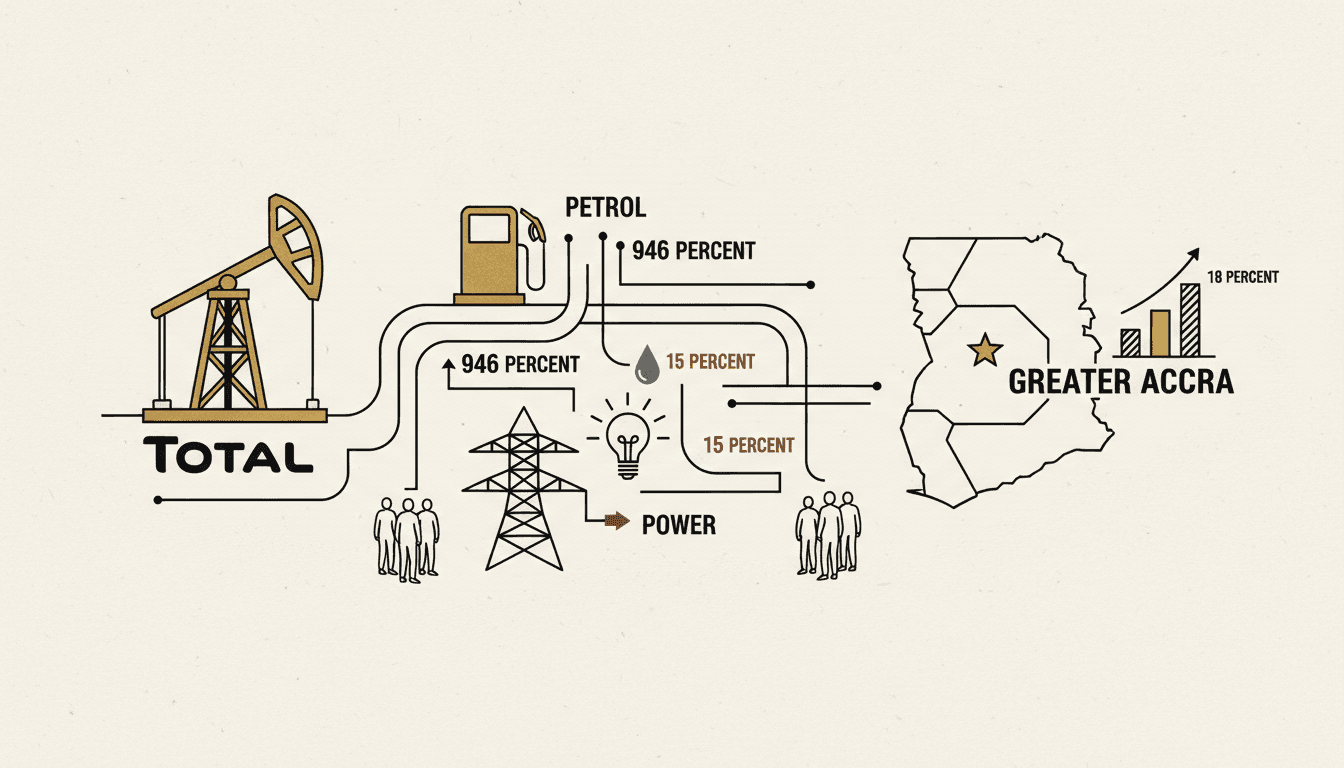
8.7 billion litres. That is total petroleum product supply and demand in Ghana for 2025, a 15.29 percent increase over 6.46 billion litres in 2024, according to the National Petroleum Authority's annual analysis. Domestic consumption accounted for approximately 7.45 billion litres of that total.
Petrol consumption rose over 18 percent to 3.1 billion litres. Diesel rose over 18 percent to 2.76 billion litres. LPG grew 10.52 percent to 376 million kilograms. Gasoil for mining operations climbed 15.71 percent to 422.5 million litres. Marine gas oil for foreign vessels surged 143.75 percent. Kerosene was the only product that declined, falling 12.24 percent.
The outlier is power generation. Fuel oil for power plants surged 946 percent. Gas oil for power plants rose 184 percent. Those two categories reflect increased thermal generation demand — a signal that either gas supply to power plants was intermittent or electricity demand outstripped base generation capacity.
Where the fuel goes
Greater Accra consumed 2 billion litres, representing 27 percent of national consumption. Upper East Region led growth at 55.5 percent, rising from 306 million to 476 million litres. December was the peak month at 712 million litres, driven by festive-period economic and social activity.
The competition story
Star Oil overtook GOIL as market leader in 2025. Star Oil volumes surged 41 percent in the first half to 403.3 million litres while GOIL declined 0.73 percent. Star Oil expanded its retail network from 191 stations at end-2023 to 254 by late 2025. New entrants Moari Oil, Yass Petroleum, and Gaso Petroleum posted triple-digit growth rates, intensifying consumer access and competitive pricing across the retail network.
The refining question
Local refineries supplied approximately 18 percent of national consumption in 2025. Sentuo Oil Refinery covered roughly 30 percent of petrol, diesel, and LPG supply in Q4 alone. The Tema Oil Refinery restart in December 2025 at 28,000 barrels per stream day adds domestic capacity that was not available for most of the year.
The 82 percent import dependency is the structural vulnerability that the World Bank flagged this week and that the Cabinet fuel tax intervention attempted to address. Consumption is rising. Domestic refining capacity is growing but remains a fraction of demand. The gap is where the Gulf crisis lands.