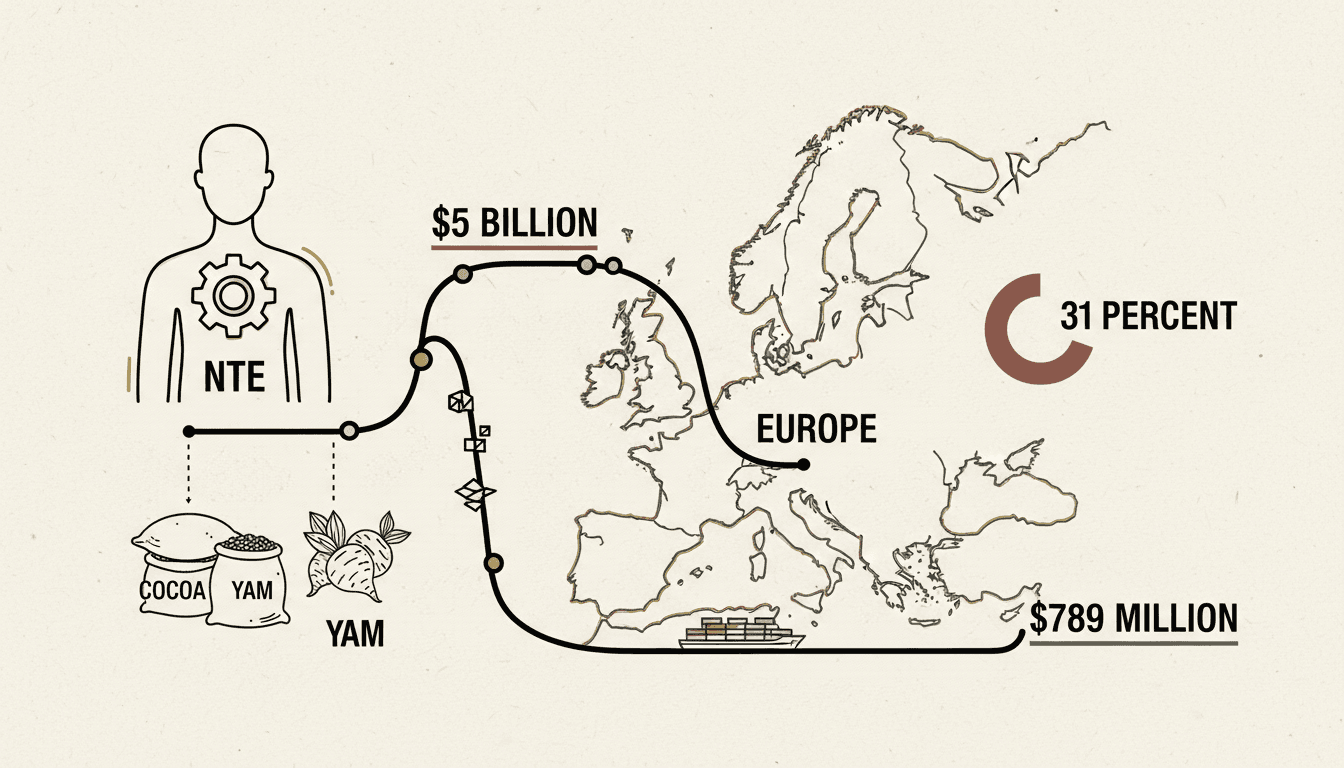
$5 billion. That is total non-traditional export earnings for Ghana in 2025, a 30.7 percent surge from $3.83 billion in 2024, according to the Ghana Export Promotion Authority. The top 10 NTE products alone generated $3.28 billion, representing 65.5 percent of the total and up 53 percent from $2.15 billion in 2024.
The composition of that top 10 is the story.
Cocoa paste leads at $789.3 million, up 71 percent. Cocoa butter follows at $635.7 million, up 120 percent. Cocoa powder sits sixth at $233.8 million, up 113 percent. Together, three cocoa derivatives account for $1.66 billion — a third of the entire NTE basket. None of them are raw cocoa beans. All are processed.
That distinction matters. Ghana and Cote d'Ivoire produce 65 percent of the world's cocoa but earn approximately 4 percent of the $150 billion chocolate industry's wealth, because most beans leave the continent raw. The government has announced that beginning with the 2026/27 crop season, a minimum of 50 percent of all cocoa beans produced must be processed locally, up from less than 25 percent currently.
The $789 million in cocoa paste is the leading indicator of whether that policy is real.
The full top 10
unknown nodeIron and steel was the only decliner. Everything else grew double digits. Processed and semi-processed goods accounted for $3.09 billion, or 83.5 percent of total NTEs.
Where the exports go
Europe took $2.29 billion, up 55.3 percent. Africa accounted for 30.4 percent of NTEs, with ECOWAS states making up over 94 percent of Ghana's intra-AfCFTA exports. North America saw 82.4 percent growth, the highest rate of any region. The top five destinations: Netherlands, Burkina Faso, the United States, the United Kingdom, and Togo.
Yam exports surged 559 percent — the single largest percentage jump in the dataset, though off a small base.
GEPA CEO Francis Kojo Kwarteng Arthur said if 10 percent of the export base can generate over $5 billion in earnings, then 20 percent will yield even greater results. GEPA is targeting $10 billion in NTE by 2030.
NTEs represent approximately 16 percent of Ghana's $31.2 billion in total exports. Gold remains dominant at approximately $20 billion. But the structural shift is in the composition: more processing, more value addition, more intra-African trade. That is the $5 billion story.