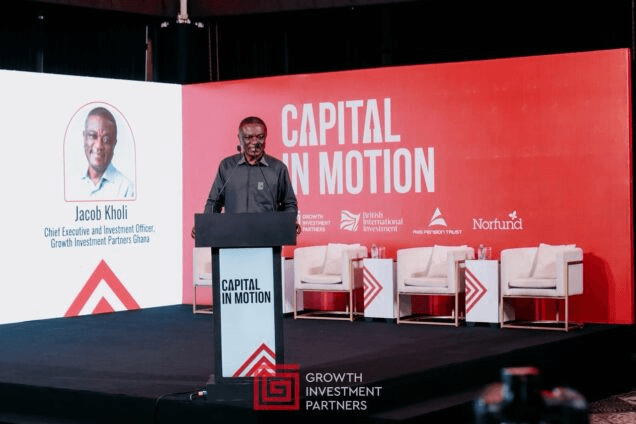
Growth Investment Partners has closed a $20 million commitment from Norfund and Axis Pension Trust. Norfund, the Norwegian Investment Fund for Developing Countries, is putting in $15 million. Axis Pension Trust, a Ghanaian licensed pension scheme administrator, is contributing $5 million.
The combination takes GIP's total capital base to roughly $70 million in cedi equivalent.
GIP is the investment platform British International Investment established in 2023 to deploy long-term, flexible capital into Ghanaian SMEs. Since launch, the platform has deployed about $41 million across 16 portfolio companies in financial services, agribusiness, logistics, and manufacturing. Those companies collectively support more than 3,300 jobs, including about 535 created since the GIP investment. Eighty-four percent of the portfolio is Black-owned or Black-led, and the same proportion meets the 2X criterion for strong female participation.
Jacob Kholi, GIP's CEO, said the addition of the two investors is "an important milestone for GIP and reflects growing confidence in our investment model." Naana Winful Fynn, Norfund's regional director for West Africa, framed the commitment as strategic for broadening institutional reach.
The platform's typical ticket sizes run from $500,000 to $5 million in local-currency equivalent. Target companies sit in a band that maps to roughly $500,000 to $15 million in annual turnover, employing between 10 and 300 people. That positioning slots GIP into the part of the SME funding curve that has historically been underserved by both commercial banks, which find the deals too small or too risky, and by venture capital, which finds them too cash-flow positive and not scaleable enough.
The interesting part of the commitment is not the $20 million. It is the pairing. DFIs and pension funds do not usually sit on the same cap table at the same time. DFIs are built for earlier and longer-tenor risk. Pension funds are built for later, more liquid positions. When both arrive at the same SME platform in the same round, it means both sides have concluded independently that GIP's structure is one they can underwrite. Norfund's commitment is consistent with its West Africa mandate. For Axis Pension Trust, it is the second pension-fund commitment into a Ghanaian alternative-investment vehicle in the past twelve months, after the pension capital that came into Ci-Gaba's first close through a similar institutional channel.
The regulatory unlock behind that second fact matters. Ghana's pension rules allow scheme administrators to allocate up to 5 percent of assets under management into alternative investments, with venture capital and private equity inside that envelope. The aggregate eligible pool, by current AUM, is roughly $300 million across the major schemes. The Axis $5 million commitment to GIP is a small slice of that pool. It is also the second visible deployment of pension capital into a domestic SME investment vehicle inside the same regulatory window. The pension-to-real-economy pipeline has stopped being theoretical.
Ghana's recent macro work should have made commercial bank SME lending cheaper. The policy rate at 14 percent and the disinflation print at 3.2 percent are the conditions under which banks typically extend credit to the exact companies GIP is underwriting. That expansion has not arrived yet. The banks are still treating SMEs in the GH¢ target band as too risky at rates they find acceptable. GIP, Ci-Gaba, and a handful of similar vehicles exist to fill that gap. Each new institutional investor that commits to one of these structures is a vote that the gap is filling.
What the announcement does not yet tell you is what GIP plans to do with the capital in 2026 specifically. The standard playbook is to deepen exposure to existing portfolio companies through follow-on rounds, write a small number of new tickets in the upper half of the $500,000 to $5 million range, and use the enlarged base as the lever for additional concessional or blended-finance commitments from other DFIs. Whichever direction Kholi's team goes, the test over the next twelve months is whether the portfolio grows meaningfully and whether jobs and revenue at existing holdings match the model that brought Norfund and Axis to the table in the first place.
The pairing is the signal to carry from this one. The Ghanaian SME finance stack now has more institutional capital sitting inside it than at any point in the past decade.
The banks can read that as an invitation to lean in on the segment, or they can continue letting non-bank structures do the work the banks could have done more cheaply. Either way, the question of who lends to a Ghanaian SME in 2026 has different answers than it had in 2022.