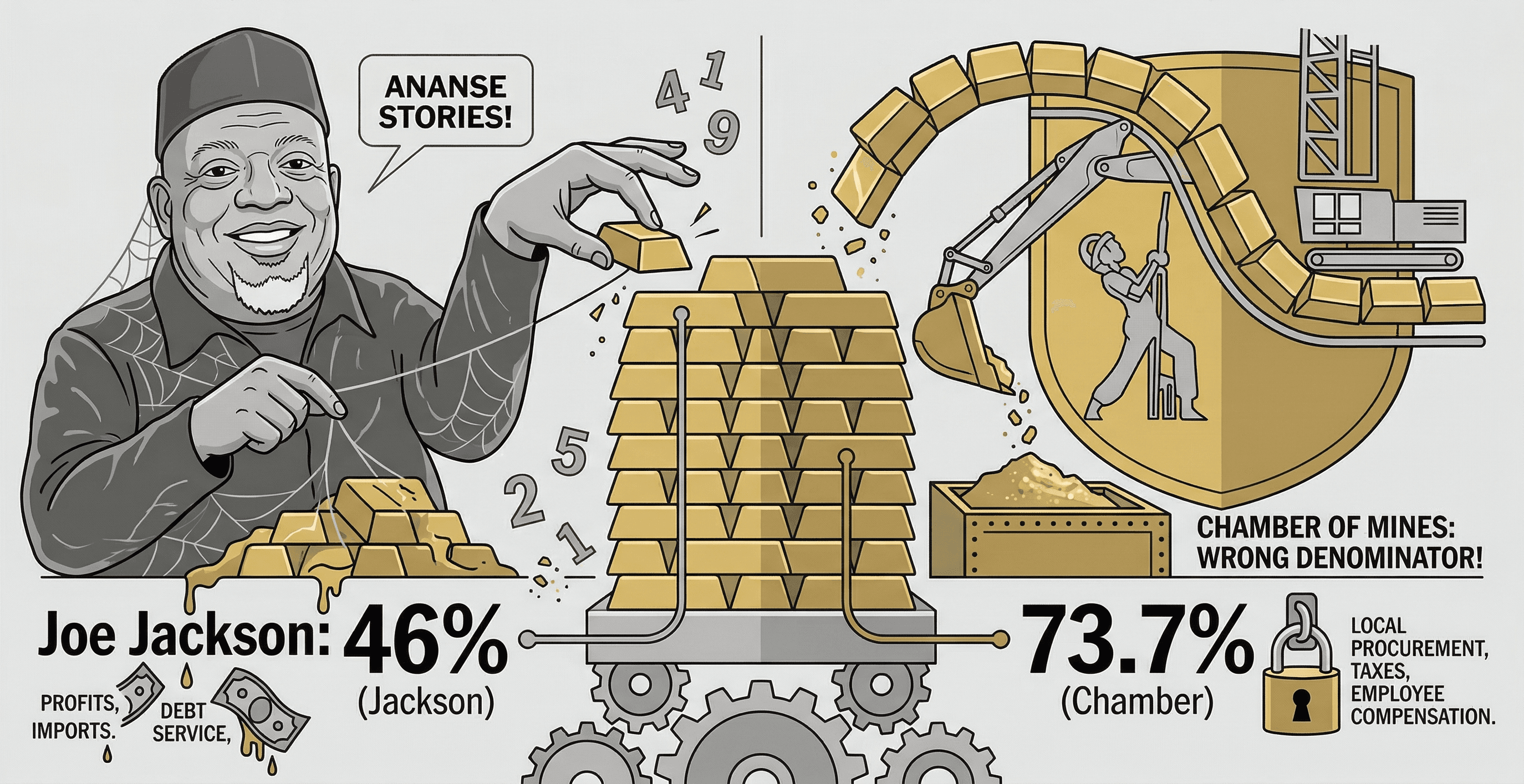
Joe Jackson, CEO of Dalex Finance, told a Chartered Institute of Marketing Ghana audience in late March that Ghana retained only 46.2 percent of the $11.9 billion in gold exported in 2024.
The rest, he argued, leaked through profit repatriation, debt servicing, service imports, and limited local participation.
He titled the lecture "Ananse Stories About the Economy of Ghana" and suggested that many accepted explanations for the cedi's weakness are, like Ananse's tales, clever but not entirely true.
The Ghana Chamber of Mines responded on 10 April with a formal statement identifying what it called a fundamental scope mismatch in Jackson's calculation.
The denominator problem
Jackson used $11.9 billion as the total gold export figure. That number covers all producers — large-scale industrial mines, medium-scale operations, and artisanal small-scale mining.
He then compared it against $5.5 billion in domestic expenditure reported by Chamber member companies. Those members are large-scale industrial producers only.
Small-scale mining accounted for approximately 40 percent of Ghana's gold exports in 2024.
The sector produced roughly 3.1 million ounces of a record 6 million ounces total.
Its domestic retention, including wages, equipment purchases, fuel, community payments, was not included in the $5.5 billion figure because small-scale miners are not Chamber members and do not report through the Chamber's frameworks.
The Chamber's point: comparing sector-wide exports against a subset's retention systematically understates how much stays in the country.
The Chamber's own number
By the Chamber's calculation, its members retained 73.7 percent of their revenue within Ghana in 2024: $2.9 billion in local procurement, $1.4 billion in taxes, and over $600 million in employee compensation.
That is $5.5 billion against their share of exports, not against the sector total.
Ghana Chamber of Mines
By the Chamber's calculation, its members retained 73.7 percent of their revenue within Ghana in 2024: $2.9 billion in local procurement, $1.4 billion in taxes, and over $600 million in employee compensation.
If small-scale mining's domestic retention were added (even conservatively, given the sector's high local-cost structure) the overall retention ratio would rise materially above Jackson's 46.2 percent.
What Jackson is actually arguing
The retention-rate dispute is the surface layer. Jackson's deeper argument is about what he called "usable foreign exchange" — the portion of export earnings that actually remains available in the domestic financial system.
Gold leaves. Dollars come in. But a significant share of those dollars leaves again through repatriation, offshore debt service, and imported mining inputs. What stays is not $11.9 billion. It is whatever is left after those outflows, and Jackson's claim is that the residual is too small to explain the cedi's structural weakness without reference to the mining sector's capital structure.
The Chamber did not engage directly with this framing. Its rebuttal addressed the arithmetic, not the capital-flow argument.
The production context
Ghana produced a record 6 million ounces of gold in 2025, a 21 percent increase over 2024.
Industrial mines contributed 2.9 million ounces. Small-scale mining contributed 3.1 million ounces, a 50 percent jump. Export revenues exceeded $10 billion. Mining's share of GDP has risen to approximately 10 percent, up from 5.7 percent in earlier years.
Fiscal revenue from the sector reached GH¢17.7 billion in 2024, a 51.2 percent year-on-year increase.
The sector is producing more gold and more revenue than at any point in Ghana's history. Whether the country is keeping enough of it is the question neither side fully answered.