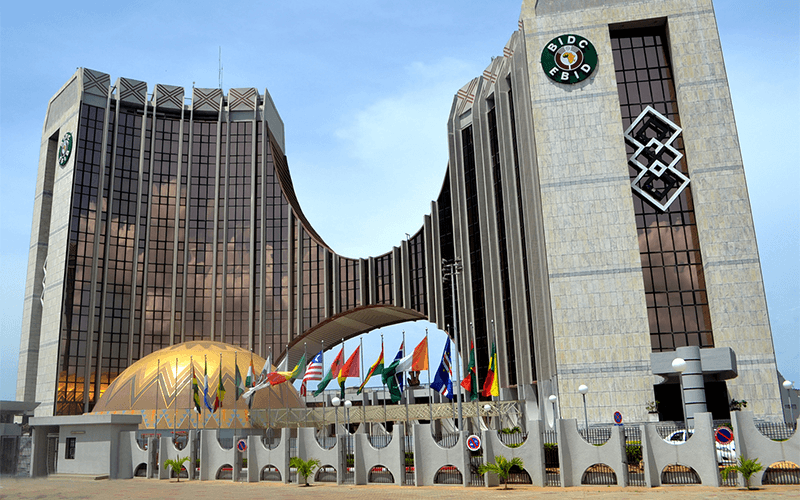
EBID disbursed $722.69 million in new funding across West Africa during 2025, a 47.7% increase over the previous year, President Dr George Donkor told the bank's Board of Governors at its 24th ordinary session at the Movenpick Ambassador Hotel in Accra on 8 April.
The figure sat inside a broader performance story.
Total assets reached $2.39 billion, up from $1.97 billion the previous year. The bank appraised 25 new projects worth $1.47 billion, a 55.8 percent jump in pipeline value. Project commitments surged 83 percent to $813.77 million, concentrated in energy and transport.
Profit came in at $9.75 million, up 13.3 percent from $8.55 million. The loan disbursement rate rose from 20.5 percent in 2024 to 26.4 percent. Moody's holds the bank at B2-Stable; Fitch at B-Stable.
Those numbers describe a regional development bank that has shifted from building its balance sheet to deploying it. The question is whether the next phase holds.
The five-year bet
Dr Donkor used the Accra meeting to launch EBID's 2026-2030 strategy, branded Growth, Resilience and Optimisation. The headline target is $2.69 billion in new resource mobilisation over five years, funded through capital calls from member states, ESG-themed bond issuances, and a push to attract investment-grade non-regional members.
Two allocation decisions inside the strategy carry the real signal. 63 percent of new commitments will go to private enterprises, positioning EBID as a private-sector-led development bank rather than a sovereign-lending shop. 41 percent of resources are earmarked for climate mitigation and social inclusion. Those two numbers overlap but do not duplicate — a single project can satisfy both criteria.
The bank will also open a second regional office in Abuja during 2026, joining Abidjan. And it is pursuing membership of the African Development Bank and the Arab Bank for Economic Development in Africa, both triple-A-rated institutions whose endorsement would lower EBID's own borrowing costs and open co-financing windows the bank does not currently have.
The Ghana channel
Ghana's position in this deployment is stronger than most member states. The country is one of four that has fully met its capital obligations to EBID, a fact Finance Minister Cassiel Ato Forson — who also serves as outgoing chairman of EBID's Board of Governors — used to push for institutional strengthening and prudent borrowing as the twin priorities for the bank's next phase.
The SME channel remains the most operationally relevant piece for Ghana. At the AGM opening, Dr Donkor confirmed that approximately 22 percent of EBID's total commitments are reserved for SME and SMI financing, channelled through commercial banks rather than lent directly. The on-lending model means the end borrower interacts with a Ghanaian bank — Ecobank, GCB, Fidelity, or Absa are the usual candidates — and benefits from a concessional rate underwritten by EBID's wholesale facility.
That 22 percent is up from the mid-teens in the bank's 2022 strategy document. Combined with the 63 percent private-enterprise allocation in the new five-year plan, EBID is building a capital pipeline that overlaps with the domestic institutional channels Ghana has been assembling: the Ci-Gaba Fund of Funds first close, the GIP platform with its $20 million Norfund and Axis Pension commitment, and the concessional lending environment created by the Bank of Ghana's 14 percent policy rate.
What to watch
The $2.69 billion target over five years averages $538 million per year in new mobilisation. EBID raised $510 million and €310 million from partners in 2025 alone, so the annual target is within range if the bank sustains its current trajectory. The risk is the capital-call component. In 2022, authorised capital was increased to $3.4 billion. The third tranche subscription call of $411.4 million had a December 2025 deadline. Only four member states are fully compliant: Ghana, Cote d'Ivoire, Guinea, and Togo. Outstanding arrears sit at approximately $256 million. States that have not met their existing obligations are unlikely to respond to new calls.
The participating commercial banks in Ghana, the indicative spread below prime for the SME facility, and the first ESG-themed bond issuance will be the three data points that tell you whether the Accra AGM produced a strategy or a slide deck.