Minority Chief Whip Frank Annoh-Dompreh pressed the NDC government on 12 April to restore fair cocoa producer prices and clear farmer payment arrears.
The statement, part of a sustained multi-week NPP campaign across cocoa-growing regions, sits on top of a structural crisis that goes deeper than any one political exchange.
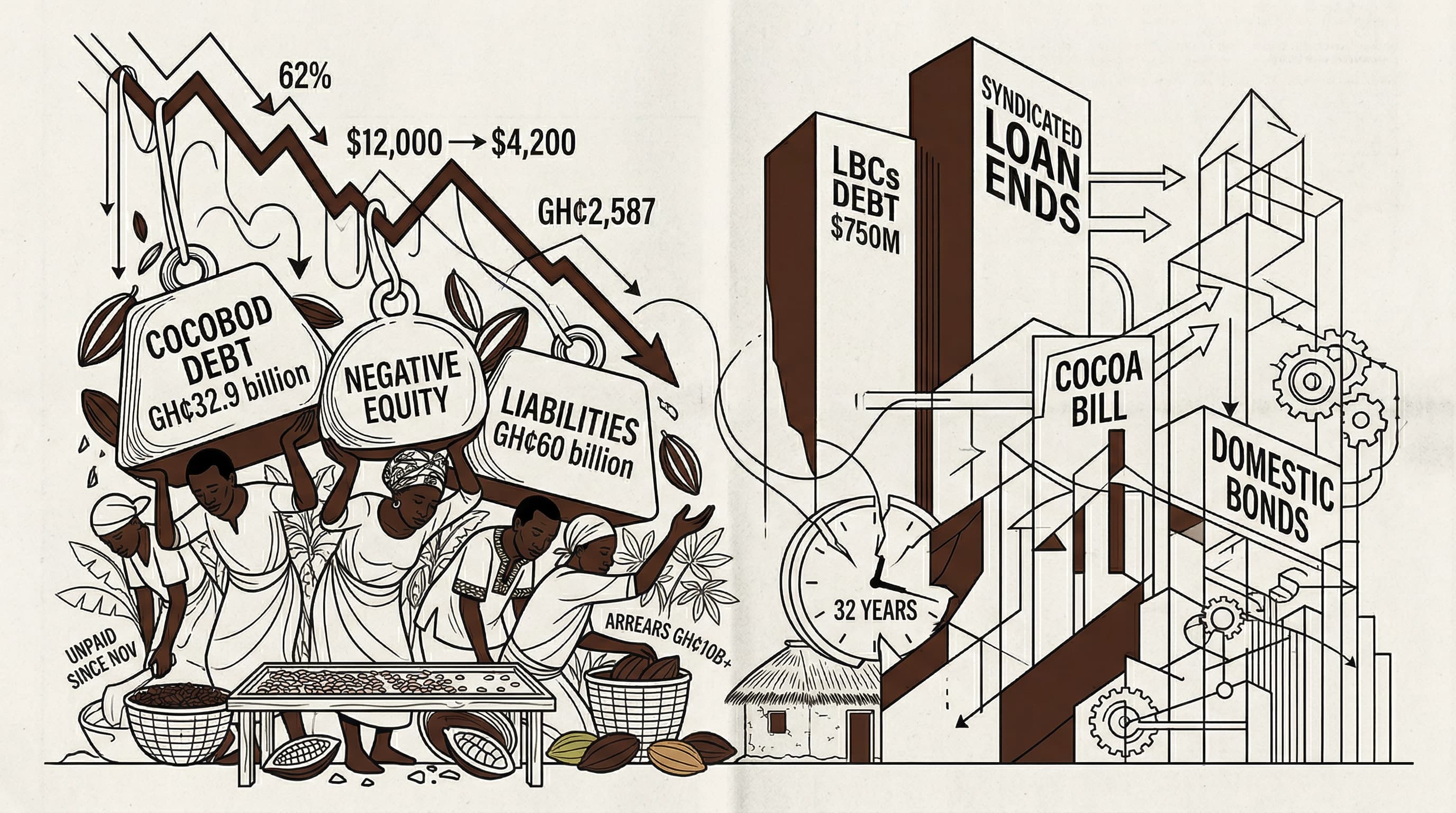
COCOBOD's total debt stood at GH¢32.9 billion at the end of 2024. The corporation has negative equity of approximately GH¢3.8 billion — liabilities exceed assets.
Total liabilities entering the 2025/26 season reached approximately GH¢60 billion, including GH¢17.8 billion in loans and GH¢26.5 billion in cocoa road contracts accumulated between 2014 and 2024.
For the first time in 32 years, COCOBOD did not raise its annual syndicated loan for the 2024/25 season because interest rates exceeded 8 percent.
The 2023/24 production shortfall — 432,145 tonnes against a projected 800,000 — cost the corporation an estimated $1 billion.
The price collapse
Global cocoa futures peaked above $12,000 per tonne in 2024. By February 2026, they had crashed to approximately $3,778 per tonne, a 62 percent decline.
By April they sat around $4,200, near 2.5-year lows. StoneX projects a global surplus of 287,000 tonnes for 2025/26 and 267,000 tonnes for 2026/27. The demand destruction caused by 2024's extreme prices is now feeding back as oversupply.
Ghana's farmgate price tracked the spike on the way up: GH¢3,228.75 per 64-kilogramme bag at the August 2025 season opening, then GH¢3,625 in October.
By February 2026, with the international market in collapse, Finance Minister Cassiel Ato Forson announced an emergency 28.6 percent cut to GH¢2,587 per bag. Ivory Coast, facing the same arithmetic, cut its mid-crop price by 57 percent in March.
The payment crisis
Outstanding farmer arrears exceeded GH¢10 billion by February 2026. Farmers in many areas reported not receiving payment for cocoa delivered as far back as November 2025. Licensed buying companies owe banks between $650 million and $750 million.
They owe farmers an additional $205 million to $234 million. LBC Association President Samuel Adimado said COCOBOD had diverted funds to non-core activities including road construction, forcing buyers to borrow commercially for farmer payments.
COCOBOD released GH¢4.2 billion to LBCs in March to begin clearing arrears. Approximately 580,000 tonnes of beans have been delivered this season but LBCs await full payment. Another 70,000 tonnes remain in fields unpurchased.
The reform package
The government responded on 12 February with a structural reform package.
A new Cocoa Bill, to be laid before Parliament, would guarantee farmers a minimum 70 percent of the gross FOB price with automatic adjustment tied to world market trends and exchange rates. The bill would replace the current system of ad-hoc government pricing decisions with a formula.
COCOBOD's financing model would shift from syndicated loans to domestic cocoa bonds, with repayments tied to sales proceeds within the same crop year. GH¢5.8 billion in legacy debt is directed for conversion pending parliamentary approval. GH¢4.35 billion in road liabilities would be transferred to the Ministry of Roads and the Ministry of Finance.
The local processing target would increase from 30 to 40 percent to at least 50 percent by the 2026/27 season, reviving the state-owned Cocoa Processing Company.
The political layer
Annoh-Dompreh's campaign is not incidental. The cocoa belt overlaps with traditional NPP strongholds.
In the 2024 election, NPP votes fell 24 percent in Ashanti, 37 percent in Western, and 34 percent in Eastern — all cocoa-producing regions. The Minority's advocacy for farmers is designed to recapture that ground, framing the NDC government as neglecting the agricultural base.
Whether the Cocoa Bill passes, the bonds are structured, and the arrears are cleared before the 2026/27 season opening around October will determine whether the reform package is policy or performance. The farmers who delivered beans in November and have not been paid are not waiting for the distinction.