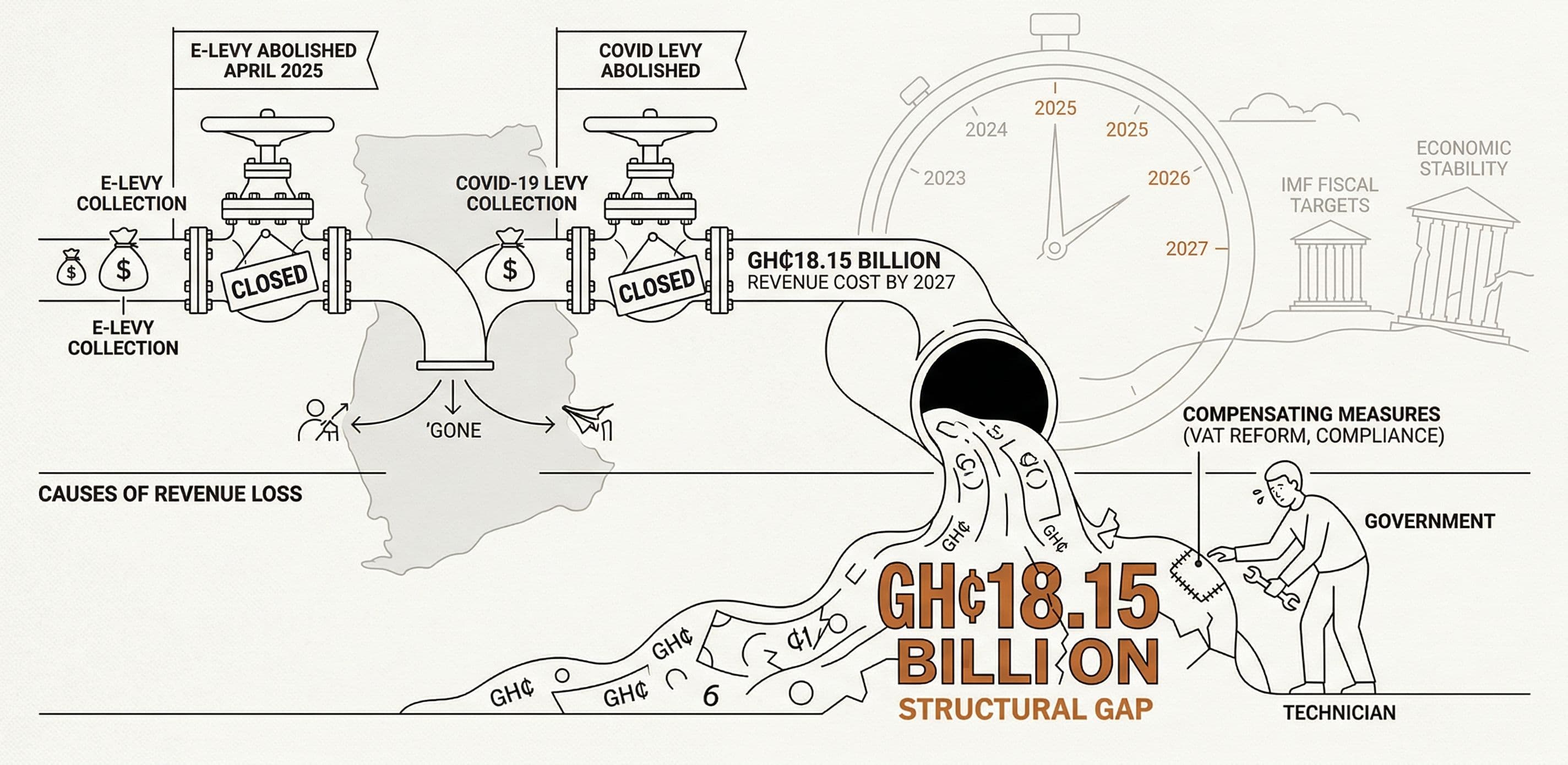
That is the cumulative revenue cost the Centre for Policy Scrutiny puts on the two levy abolitions, projected through the end of 2027.
The E-levy side of that number is about GH¢8.2 billion. The Covid health recovery levy side is about GH¢9.95 billion.
The study was presented in Accra this week by Isaac Danso Agyiri, the centre's fiscal policy specialist. Dr Adu Owusu Sarkodie is the Centre's executive director.
The base for the projection is what the two levies were collecting before they were taken off the books. The Covid levy moved from GH¢1.72 billion in 2022 to about GH¢2.94 billion in 2024. The E-levy was clearing more than GH¢1.8 billion in 2024 before its April 2025 abolition. CPS extrapolates those collection curves forward through 2027 with standard growth assumptions, then treats the gap between the projected revenue and the actual post-abolition collection as the foregone amount.
The compensating measures the government has identified are reforms in the VAT system, enhanced compliance enforcement, and adjustments to the tax refund regime.
The CPS view is that those measures, taken together, may not fully offset the losses. That is the operative sentence in the report.
GH¢18.15 billion is the same order of magnitude as the IMF Extended Credit Facility programme's annual primary balance target. A revenue gap of that size, spread across two and a half fiscal years, lands directly on the indicator the IMF is grading the country against.
Whether the gap clears through compensating revenue or through expenditure compression is the question the Ministry of Finance has not yet answered publicly.
The political economy around the abolition made it always going to be difficult to walk back. The E-levy in particular was the tax line that defined the previous administration's domestic political vulnerability. Reinstating any version of it is not a credible policy option for the current government. Compensating revenue has to come from somewhere that does not look like an E-levy, which is the constraint that makes the arithmetic harder than the straight tax-base arithmetic would suggest. VAT base broadening, the most obvious candidate, is itself politically expensive at the current rate and exemption structure.
One thing the GH¢18.15 billion number is not: anything central bank profits can plug. The recent $1.3 billion BoG gold reserve sale has been mentioned in some analyst commentary as if it is available to cushion the fiscal side. It is not. Central bank profits cannot legally be used to plug recurring fiscal expenditure under the Public Financial Management framework. Even if they could, the gold profit is a one-off realised gain tied to the November-December 2025 reserve transaction. The CPS revenue gap is structural. The two numbers do not belong in the same sentence on a ministry balance sheet.
The compensating-measures conversation will accelerate through the rest of Q2. VAT reforms specifically have been signalled by the Ministry of Finance over the past quarter. The shape and scale of those reforms will determine whether the GH¢18.15 billion number lands as a cumulative shortfall on the public ledger or as a budgeted hole the Ministry has a credible plan to close. The newly constituted Fiscal Council is the body whose first substantive output should be an independent read on whether that plan exists.
The CPS number is a projection, not a reported outturn. It is built on collection trends that held until April 2025, and the collection trends for 2026 and 2027 are the ones that will determine whether the shortfall comes in at GH¢18 billion or somewhere else. What matters between now and the mid-year budget review is whether the Ministry publishes a compensating-revenue plan that Fiscal Council can credibly grade. If that plan appears, the number is a budgeted gap. If it does not, the number is a hole.