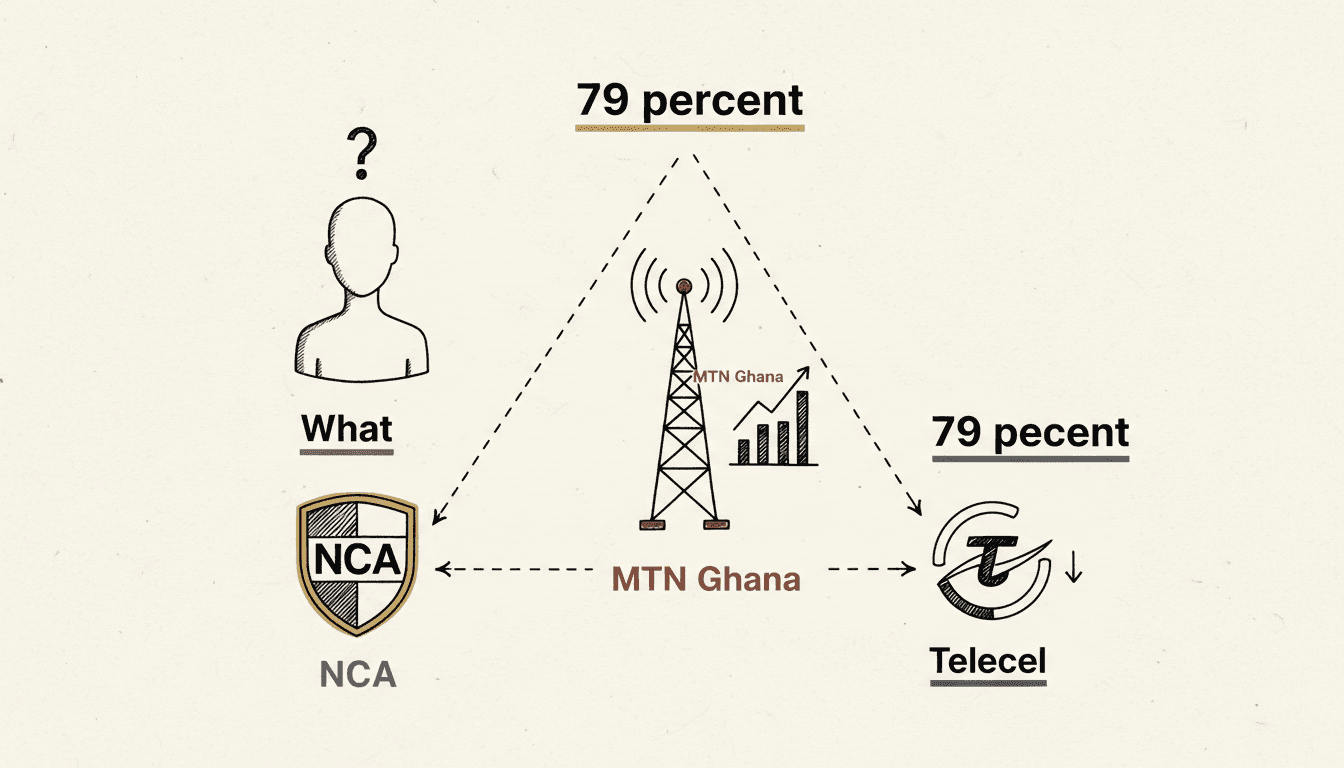
MTN Ghana held 61 percent of the market in early 2022. By April 2026 that number was 79 percent. Telecel sits at roughly 15 percent. AT Ghana, once a third competitor with market share above 25 percent in 2018, has collapsed to about 6 percent, is owed to the state, and is being absorbed into Telecel. The National Communications Authority's tools for acting on concentration of this kind were designed for a market that no longer exists.
The Authority's most recent substantive move is a tightening of quality-of-service standards published in February 2026. The maximum permitted call drop rate fell from 3 percent to below 1 percent. Call connection success rates must exceed 95 percent. Data speeds must average at least 1 megabit per second across every district assembly, and for the first time coverage requirements extend beyond district capitals to the constituent towns within those districts. Taken together, the directive is the most demanding set of operator obligations the NCA has issued.
The question is what enforcement looks like in practice. MTN's 79 percent share is the product of eight years of consistent network capital expenditure, aggressive pricing, and a customer behaviour shift toward data that its competitors have not been able to match at the same pace. A QoS directive applied uniformly to all three licensed carriers will bind hardest on the weakest. AT Ghana, which reportedly requires an estimated $600 million over four years to return to competitive strength and which currently owes more than $150 million, cannot meet the new thresholds without capital it does not have. Telecel is closer to viable but is simultaneously absorbing AT Ghana's subscriber base, which will stretch its own network for the duration of the migration. The effect of stricter QoS rules in this context is to raise the floor the weakest operator cannot reach, not to constrain the dominant operator.
The Authority designated MTN as having Significant Market Power in 2020 under Section 20 of the Electronic Communications Act. MTN challenged the designation in court before withdrawing the case, and the designation has remained in force. SMP status is supposed to attract obligations around access pricing, infrastructure sharing, and cost-oriented tariffs. In practice, the designation has not changed the shape of the market. Subscribers continued to migrate toward MTN, data market share approached 80 percent, and interconnection disputes remained the flashpoint rather than a resolved mechanism. MTN's completion of the MoMo separation into a standalone fintech entity earlier this year removed any lingering argument that the company's financial services arm could be used as a counterweight to its telecom dominance.
The structural position of AT Ghana is the part of the story most worth understanding. The carrier is now government-owned following the 2021 acquisition that formalised what had been an effectively state-backed arrangement since the merger of Airtel and Tigo in 2017. The treasury cannot recapitalise it at the scale required without creating an accounting problem inside the IMF programme. A sale to Telecel in its current form is the route the Ministry of Communications and the Ministry of Finance appear to have taken. The subscriber migration is underway; the asset transfer is more complicated because it involves licensing, frequency allocations, and the tower and fibre holdings that sit on AT Ghana's balance sheet at book values the buyer will not accept.