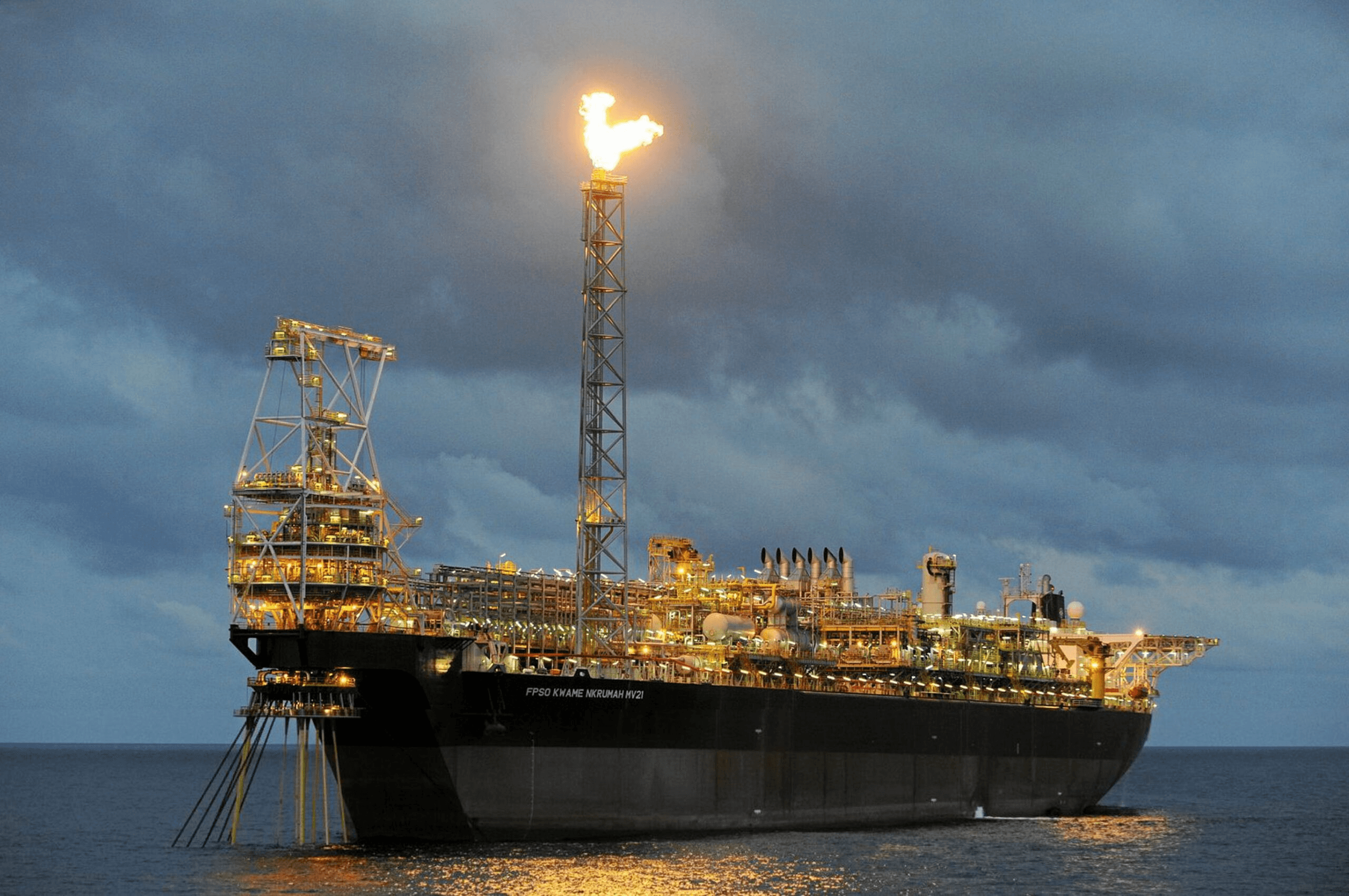
Ghana has produced 694 million barrels of crude oil since commercial production began in 2010, the Public Interest and Accountability Committee said in its 2025 annual report.
Peak output was 2019 at 71.44 million barrels.
Every year since has been lower than the one before it.
The 2025 breakdown by field: Jubilee at 22.21 million barrels and an average 63,280 barrels per day; TEN at 5.83 million barrels and 15,985 bpd; SGN at 9.26 million barrels. Total: about 37.3 million barrels for the year, roughly half of the 2019 peak.

PIAC Chairman Richard Ellimah said the country needs "sustained oversight and prudent management of petroleum revenues to ensure that the country derives maximum benefit from its natural resources."
The subtext is harder to miss: the revenue pool is shrinking.
Oil entered 2025 already third in the country's export earnings, behind gold at $20 billion and cocoa at $3.8 billion after gold's record surge. That order was not where the Jubilee promise expected to leave things by 2025.
What was once framed as the third forex pillar alongside gold and cocoa is now the smallest of the three.
The fiscal question is narrower than the production question.
Roughly $434 million of 2025 oil revenue was allocated to the Big Push Programme. If production continues to drop on the same trajectory, the allocation formula that underwrites that programme is operating on a base that gets smaller every year.
The conversations about the debt glidepath and the IMF programme's quantitative targets will need to absorb the shrinkage.
So will any argument the Ministry of Finance wants to make about oil as a counter-cyclical buffer the next time the cedi comes under pressure.
“Ghana needs sustained oversight and prudent management of petroleum revenues to ensure that the country derives maximum benefit from its natural resources.”
— Richard Ellimah, Chairman, Public Interest and Accountability Committee
The January growth reading is already signalling the downstream effect: industry sector growth slowed to 7.2 percent from 9.7 percent last January, with the Statistical Service attributing the slowdown specifically to oil and gas within mining and quarrying. One data release is explained by the other.