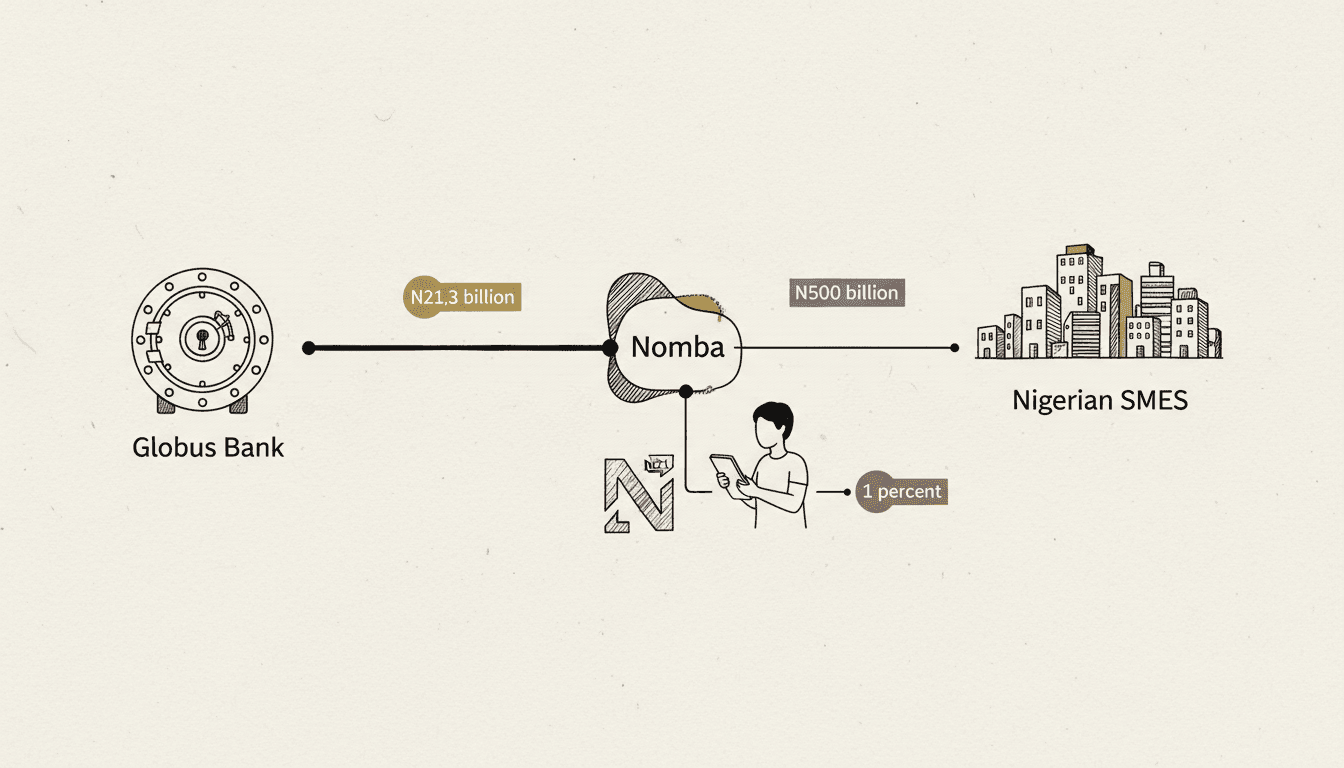
Nomba and Globus Bank have deployed N21.3 billion in credit to Nigerian SMEs over an 18-month pilot, with a non-performing loan ratio below 1 percent across the entire portfolio, Techpoint Africa reported on 9 April.
The sub-1 percent NPL figure is the number that matters. Business-lending default rates in Nigeria routinely sit above 5 percent. Nomba's argument is that the difference is the underwriting method: every loan is sized against live POS transaction data from the merchant's Nomba account, not against historical financials or collateral documents. Average disbursement is roughly 1 percent of a business's annual revenue. The ideal borrower is generating around $1 million a year or has a clear path to that scale.
The collateral framework is where the model gets interesting. Instead of physical collateral, Nomba ties the borrower's access to its payments infrastructure — POS terminals, settlement flows, business tools — directly to credit behaviour. A merchant that defaults risks losing the platform their business runs on. The repayment incentive is not a collections team. It is continuity. Businesses can also commit 30 percent of the loan amount in cash, or pledge alternative assets including stocks, stablecoins, or equity stakes.
Wholesale and retail businesses account for 39 percent of the loan book. Professional services take 28 percent. Food and hospitality and oil and gas each hold 11 percent. FMCG accounts for 8 percent. The sub-1 percent NPL holds across all five sectors.
The partners
Nomba was founded in 2016 by Pelumi Aboluwarin and Yinka Adewale and has raised approximately $42.7 million across six rounds, including a $30 million pre-Series B in 2023 led by Base10 Partners with Partech, Khosla Ventures, and Shopify. The company now serves more than 600,000 Nigerian businesses through 300,000 deployed POS terminals.
Globus Bank, led by MD/CEO Elias Igbinakenzua, provides the regulated banking licence and balance-sheet capital. The bank met the Central Bank of Nigeria's recapitalisation threshold in March 2026, raising paid-up capital above N200 billion through two rounds totalling over N155 billion. That capital base is the foundation for what comes next.
The expansion bet
Nomba's target is to grow the loan book from N21.3 billion to N500 billion by partnering with additional institutional credit providers — commercial banks and development finance institutions. Expansion will prioritise logistics, manufacturing, and healthcare.
CEO Adewale said the right question is not how much has been deployed but how much has come back and why. Globus Bank's Igbinakenzua said the NPL performance is evidence of what data-driven deployment can achieve.
The Ghana parallel is direct. Formal credit penetration remains shallow; more than half of borrowing flows through semi-formal or informal channels. No POS-transaction-backed lending pilot at this scale has been publicly reported here. The closest analogue is , which uses wholesale development capital rather than transaction data. Both route around the same gap from different directions.