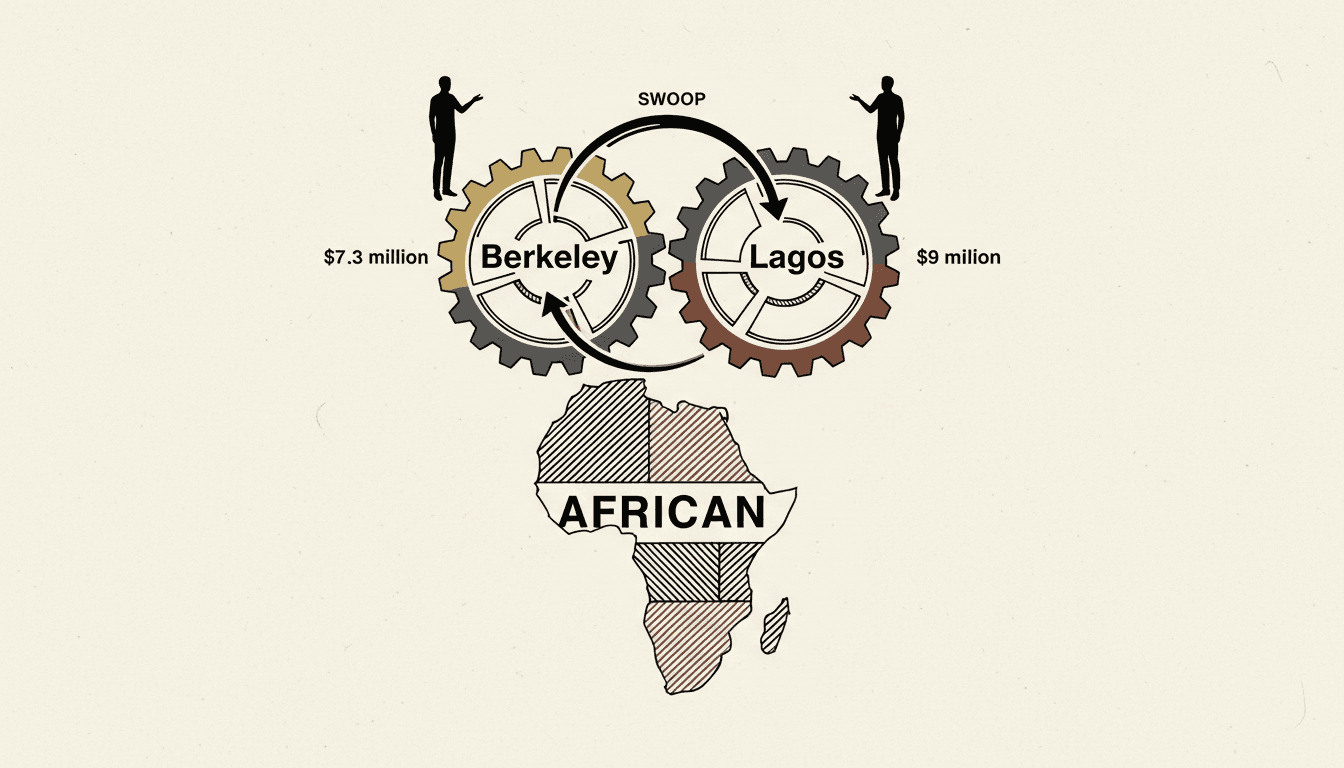
Swoop, a food delivery app launched in Lagos in April 2026, has raised $7.3 million in one of the largest disclosed seed rounds for an African consumer startup. The round was led by a group of Silicon Valley investors including Long Journey, Variant, Version One, Dune Ventures, Soma Capital, Zero Knowledge Ventures, Walter Kortschak, and Base Capital.
The founder and CEO is Aubrey Niederhoffer, 19 years old, from the New York area. He dropped out of UC Berkeley's Haas School of Business after freshman year. He is a Thiel Fellow and received the programme's $250,000 grant. His co-founder is Edwin Ruiz. Demola Adesina serves as Nigerian country manager. The team now stands at 28 people.
Niederhoffer got interested in Africa as a "tween" through Geoguessr. At 15 he started a recruiting company in Eswatini. The summer after his first year at Berkeley, he launched a food delivery app in Eswatini called Thumo that acquired 6,000 users in its first month. He moved the business to Lagos in autumn 2025.
The super-app thesis
The stated vision is an African super-app modelled on Kaspi in Kazakhstan and WeChat in China. Food delivery is the wedge. Payments, groceries, and ride-hailing are the planned layers. The launch market is Yaba, Lagos Mainland — a neighbourhood already served by Chowdeck, Glovo, and FoodCourt.
Niederhoffer's pitch: in Africa there is no legacy banking infrastructure, and that creates the opportunity. Adesina's framing: it is super hard to build a super app, and the investors recognise that.
The market case is real. Nigeria's food delivery market reached $1.1 billion in 2025, up 187 percent between 2021 and 2024 per Paystack data. But the competitive case is harder. Chowdeck has 2 million registered users, 20,000 riders, and operates across 14 cities in Nigeria and Ghana. It grew from 319 users in October 2021 to 2 million in 2025 and closed a $9 million Series A from Novastar and Y Combinator in August 2025. It is profitable.
Jumia Food is the cautionary tale. It shut down in 2023 after reportedly losing $1.80 for every $10 it earned.
The operational questions
Swoop has been operating in fair weather conditions. Lagos traffic, infrastructure gaps, and the rainy season have not yet tested the model. The food delivery space in Nigeria is described by Adesina as significantly under-penetrated — a claim that looks different when Chowdeck already has 2 million users in the same addressable market.
Ghana sits on the expansion roadmap by implication. Chowdeck already operates in Ghana. If Swoop follows the same pattern — Nigeria proof-of-concept, then Ghana corridor, then rest of West Africa — Ghanaian creators and merchants become part of the addressable base within 12 to 18 months.
Whether $7.3 million is enough to compete with a profitable incumbent that has a 4-year head start is the question the market will answer. Whether a 19-year-old outsider can build the super-app that African founders with deeper local networks have been trying to build for a decade is the other one.