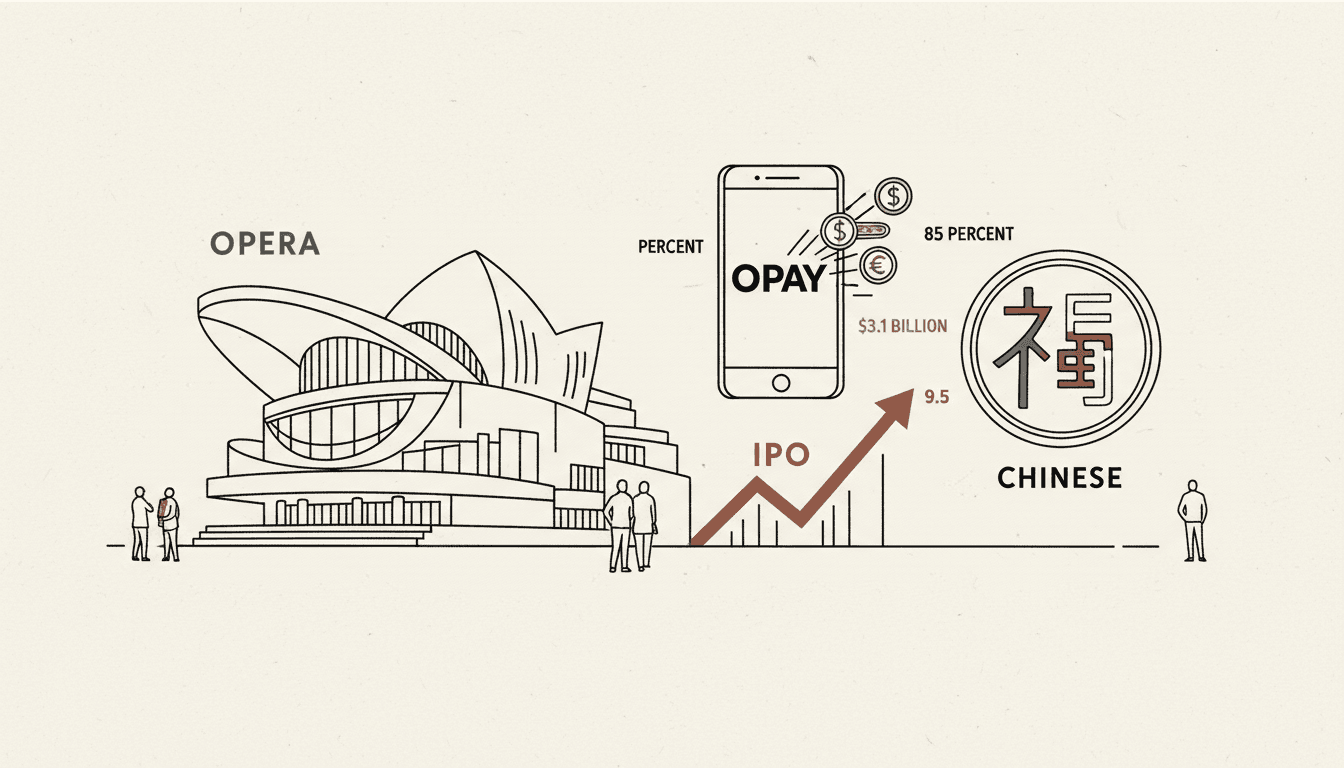
Opera, the Norwegian-Chinese browser company that incubated OPay in 2018, assigns an 85 percent probability to the Nigerian fintech listing publicly within two years, according to recent Opera securities filings. Opera values its 9.5 percent stake at $294.6 million, implying a total OPay valuation of approximately $3.1 billion — up from the $2 billion valuation at its 2021 SoftBank Vision Fund-led Series C.
The company operates across Nigeria, Egypt, Pakistan, Indonesia, Ghana, South Africa, Tanzania, Morocco, Ethiopia, Algeria, and the UAE. It has over 50 million registered users in Nigeria alone, approximately 10 million daily active users, one million merchants, and processes $12 billion in monthly transaction volume — the equivalent of roughly N9 trillion.
What $3.1 billion buys you
At $3.1 billion, OPay would sit roughly equal with Flutterwave's $3 billion valuation from its February 2022 Series D, and three times Interswitch's $1 billion valuation from Visa's 2019 minority investment. It would be the largest African fintech IPO ever attempted. The listing exchange has not been specified publicly, though industry speculation points toward a US listing.
Opera recognised $36.3 million in unrealised fair-value gains on OPay in 2025, approximately 6 percent of its reported net income. The December 2025 leadership reshuffle — James Zhou moving to Executive Chairman, former Opera CEO Lars Boilesen joining as Co-CEO, 25-year Citigroup banker James Perry as CFO — is the clearest signal yet that the IPO pathway is being built, not just priced.
The agent test
OPay's growth was built on its PoS agent network. The Central Bank of Nigeria's single-principal rule took effect on 1 April 2026, requiring each agent to work with only one financial institution. Cash-in/out caps were set at N100,000 daily and N500,000 weekly. Mobile and itinerant PoS operations were banned.
OPay is reportedly losing agents to Moniepoint as the exclusivity deadline arrives. Moniepoint has embedded SME operating-system features — inventory, tax, working capital — that raise switching costs. OPay's response will be a test of whether the 50 million-user digital channel can carry valuation growth independently of the physical agent base.
The IPO thesis rests on three things: continued user growth beyond 50 million, transaction volume continuing to compound from the current $12 billion monthly, and OPay proving its digital-first strategy survives the CBN agent restructuring. Opera's 85 percent probability says the parent believes all three are tracking. The next twelve months will show whether the market agrees.