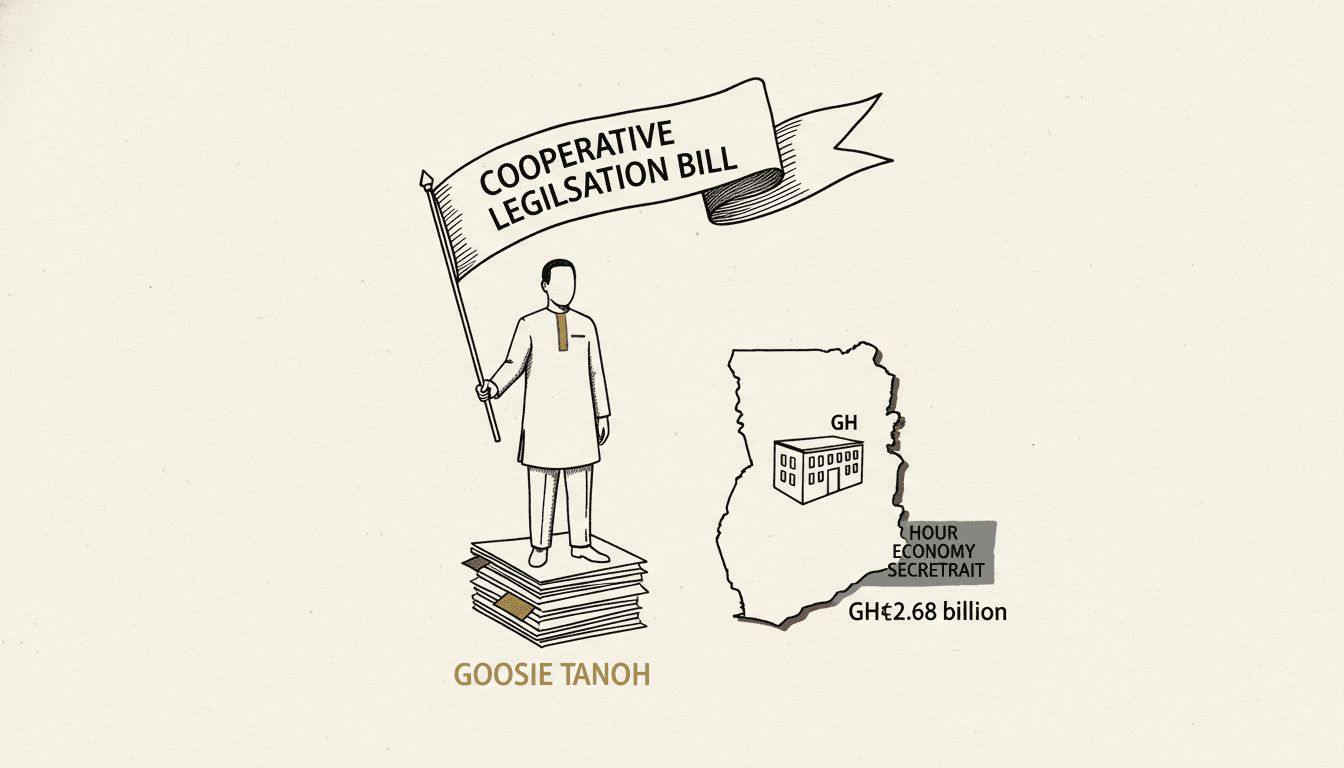
The 24-Hour Economy and Accelerated Export Development Secretariat, led by Augustus Goosie Tanoh, has proposed replacing NLCD 252 — the Co-operative Societies Decree of 1968 — with new Cooperative Legislation and creating a Solidarity Fund to capitalise the sector. The proposal sits inside the broader 24-Hour Economy framework, but its implications run beyond it.
Approximately 5,800 cooperative societies are registered in Ghana, serving roughly 3.5 million members across credit unions, agricultural cooperatives, transport unions, market women's associations, and savings groups. The Credit Unions Association alone reports 490 affiliated unions with GH¢2.68 billion in combined assets. These are not marginal numbers. They are the savings, credit, and producer-aggregation infrastructure that operates underneath Ghana's regulated banking system, particularly in rural and peri-urban areas.
The legal framework governing all of it is 58 years old.
What NLCD 252 actually does
The Co-operative Societies Decree 1968 (NLCD 252) was issued under the National Liberation Council military government. It establishes the office of the Registrar of Cooperatives, sets minimum membership requirements, defines the bylaws every cooperative must adopt, and gives the Registrar broad supervisory authority — including to suspend boards, audit accounts, and dissolve societies that operate outside their registered scope.
The decree was written for a cooperative movement that, in 1968, was largely agricultural marketing boards, urban consumer societies, and a small number of savings and credit cooperatives. It does not contemplate digital member registries, mobile-money-based contributions, inter-cooperative lending pools, or the kind of cross-border remittance partnerships that cooperative societies in Kenya, Rwanda, and Tanzania have built over the past decade.
The Department of Cooperatives sits under the Ministry of Employment, Labour Relations and Pensions. The Registrar's office is staffed at levels appropriate to a 1968 caseload, not a 2026 one. Sector observers have for years described the supervisory infrastructure as functionally absent in many regions — registrations happen, dispute resolution rarely does.
What Tanoh's proposal contains
The 24-Hour Economy Secretariat's proposal has three operational components, based on its public outline.
The first is new Cooperative Legislation that would replace NLCD 252 with a modernised Act. Specifics on the draft bill have not been publicly released, but the framing is consistent with what the African Confederation of Cooperative Savings and Credit Associations and the International Cooperative Alliance have been pushing across the region — separate prudential rules for financial cooperatives, recognition of digital member infrastructure, clearer pathways for inter-cooperative federation, and supervisory authority that scales with sector size.