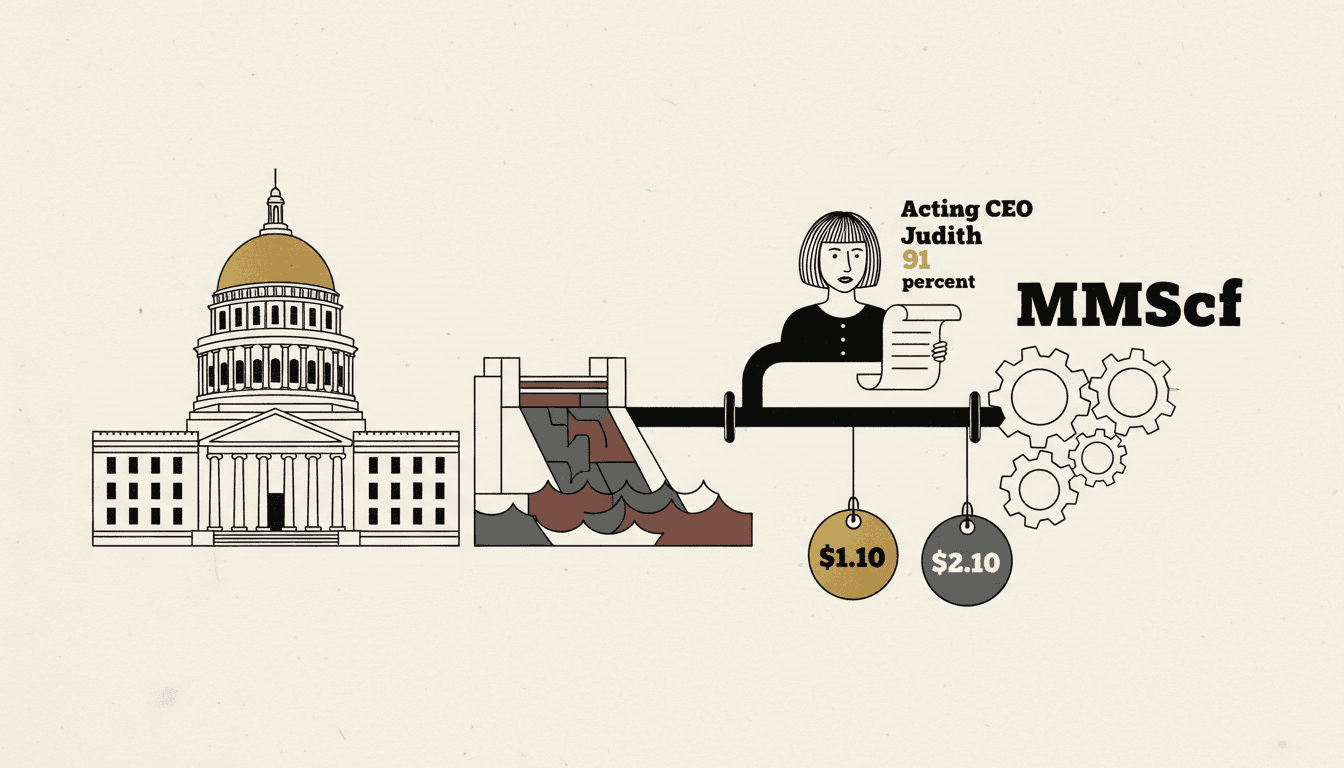
Parliament's Select Committee on Energy gave Ghana National Gas Company a public vote of confidence on 24 April. Committee Chair Emmanuel Kwasi Bedzrah said Ghana Gas is on top of its game, that the company has Parliament's full support, and that the Committee will work to address challenges, including concerns about high tariffs.
The timing matters. The day before, a fire at GRIDCo's Akosombo control facility cut approximately 1,000 MW from a national grid where peak demand sits around 4,400 MW. Ghana had marked roughly ten months without load-shedding before the blaze. Energy Minister John Jinapor commissioned a seven-member committee to investigate.
Parliament's backing of Ghana Gas with a tariff caveat, 24 hours after the country's largest hydro plant burned, is the political cover the company needs ahead of a tariff fight that has been building for months.
What Acting CEO Blay has done
Judith Adjobah Blay was appointed Acting CEO by President Mahama in March 2025. Within a year, Ghana Gas output rose from approximately 100 to 120 MMScf/day, against the Atuabo plant's 150 MMScf/day design capacity. Reduced plant downtime drove the gain. Blay told the Committee Ghana Gas is ever ready and that production has gone up while operations have improved.
Ghana produced approximately 130.4 billion standard cubic feet of raw gas in H1 2025, with Sankofa-Gye Nyame at 53 percent, Jubilee at 26 percent, and TEN at 21 percent. Blay's roadmap includes a second gas processing plant, a third gas compressor, and a Takoradi-Tema pipeline.
The tariff Parliament is being polite about
Ghana Gas has applied to the Public Utilities Regulatory Commission for a transmission tariff increase from approximately $1.10 to $2.10 per MMBtu — a 91 percent jump. Some PURC documents cite a proposed $2.422/MMBtu opening level.
That number sits inside a much larger one. PURC's Weighted Average Cost of Gas for power plants — which includes WAGP imports, Sankofa, and other supply — was approved at $7.87/MMBtu for the 2026-2030 control period, up from $7.71 in late 2025. The transmission tariff is one component of the WACOG that ultimately flows into VRA and ECG fuel-recovery charges and ends at the consumer's electricity bill.
The energy sector debt is the structural reason both numbers matter. Total energy sector debt stands at GH¢80 billion (~$5.6 billion). ECG alone owes GH¢60 billion to power producers and gas suppliers. Government paid $1.47 billion in 2025 to settle arrears with over $1.1 billion still outstanding to IPPs. Without reform, the sector deficit could top $9 billion in 2026.
What Jinapor has been doing
The Energy Minister has been moving in parallel to the Ghana Gas restructuring. He announced a $2 billion Jubilee Partners agreement to drill 20 new wells, dropping the gas price from $3.10 to $2.50 per unit and adding 70 MMScf/day in consumption. A $1.5 billion MoI with Offshore Cape Three Points partners completes a $3.5 billion investment package. He cancelled 202 contracts described as wasteful, renegotiated IPP agreements, and cut sector debt by approximately $500 million.