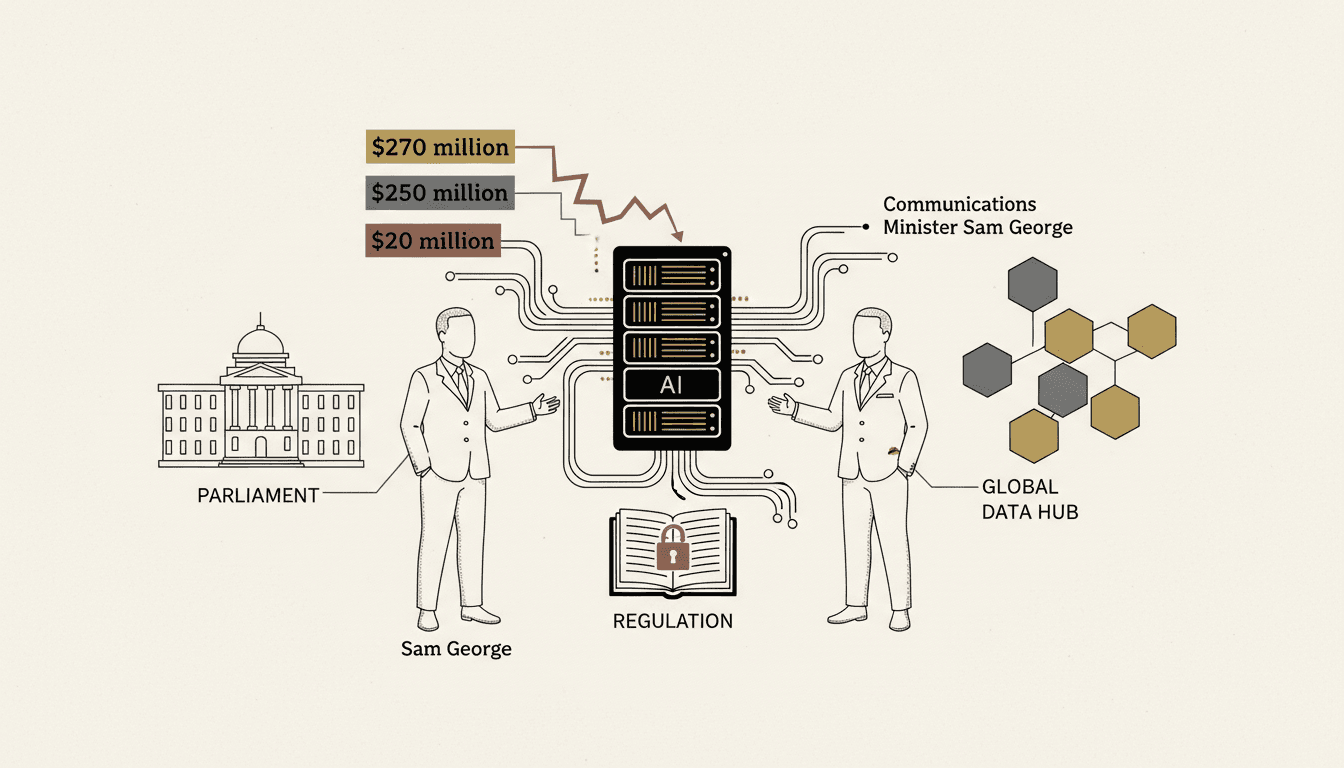
Communications, Digital Technology and Innovations Minister Samuel Nartey George launched Ghana's National Artificial Intelligence Strategy in April 2026 with what is — by Ghanaian standards — a serious envelope behind it. Cabinet approved a $250 million AI Computing Centre. The strategy itself carries a $20 million implementation budget. Eight pillars cover infrastructure, data governance, talent, ethics, sectoral deployment, research, public-sector adoption, and regional positioning. Smart Africa, GIZ FAIR Forward, and The Future Society are partner organisations on record.
Sam George's framing at launch was deliberately collective. The strategy is not solely the work of the Ministry, he said. It reflects the collective intelligence of a nation. The Cabinet AI Boot Camp at Safari Valley Resort with UNDP — a sitting Cabinet of ministers stepping out of Accra to be briefed on what AI actually does — is the kind of executive-branch signal Ghana has not produced before on a technology file.
Days after the launch, Kwesi Amoafo-Yeboah — Chairman of Dodo Technologies, the Ghanaian AI company whose CEO Kane Mani was publicly endorsed by Sam George in November 2025 — published an op-ed titled "Ghana's AI moment: We've seen this before." It is not an attack. It is a friendly-but-skeptical critique from inside the ecosystem the strategy claims to represent.
The argument Amoafo-Yeboah is making
The op-ed's core line: Ghana didn't catch up. We moved on. The reference is to past technology moments — mobile money, fibre rollout, the early fintech wave — where Ghana started early, lost the lead, and watched Kenya, Nigeria, and Rwanda pull ahead while local capacity stayed where it was.
Amoafo-Yeboah's prescription is not bigger budgets. It is a narrower problem statement. Not big AI, he writes. Useful AI. The real constraint is not effort. It is friction.
Friction in his telling is the layered cost of getting anything done in the public sector — procurement that takes 18 months, agencies that cannot share data because each runs its own database with its own format, regulators that respond to new technology by issuing committees rather than rules, and ministerial reshuffles that reset programme leadership every cycle. A $270 million package, the argument goes, can pour resources at the symptoms without touching the underlying friction.
That argument matters because Amoafo-Yeboah is not an outsider lobbing critique. Dodo Technologies is the kind of company the strategy is ostensibly meant to enable. When Sam George endorsed Kane Mani in November, he was endorsing the model the strategy now wants to scale. The Chairman of that company saying the framework needs sharper edges is the closest thing to a peer review the strategy is going to get publicly.
Publican AI is the live test
The Publican AI dispute at Tema Port is happening in real time. The system flags between $3 million and $3.5 million per day in potential undervaluation revenue. GUTA struck against it on 13 April and after talks at Ghana Shippers' House. A coalition of seven trade organisations is still in opposition. An internal GRA memo telling officers to apply only the higher of the system value or the declared value sits at the centre of the WTO Customs Valuation Agreement question.