

The Accra Goods Market published a LinkedIn post announcing that the eleven-year-old pop-up marketplace is evolving into "a fintech-enabled Retail Operating System" aimed at the creative economy.
The post ran through the company's track record (over 60 markets hosted, more than 2,500 merchants featured, 90 percent of them female-led), listed its existing brand and bank partnerships, and sketched a vision for a year-round hybrid retail ecosystem built on integrated payments, commerce infrastructure, and working capital access for small businesses.
The news hook is the pivot.
The more interesting question is whether the pivot is a genuine strategic evolution backed by committed engineering and capital, or a repositioning exercise that renames an event business as a technology platform because the technology platform narrative raises different kinds of money. Both readings are defensible on the public information available this week, and both matter to different audiences inside Ghana's creative economy.
Before the pivot question, the track record.

Makafui Ayimey founded The Accra Goods Market in 2015 as a pop-up marketplace for food, fashion, and design goods.
For its first several years, the format was stable and the growth came from cohort-by-cohort curation rather than from scaling infrastructure. Each market would host a few dozen merchants, draw a few thousand attendees, run for a day or two, and reset.
The brand built a reputation as the most reliable curator of emerging consumer brands in Accra and, over time, as the first commercial visibility moment for many of the founders whose companies are now the recognisable names in Ghana's consumer goods space. Sixty-plus markets across eleven years is the operational scale the company has built. Twenty-five hundred merchants cumulatively passed through its platform, many of them more than once, and 90 percent of the merchant base has been women running food, beauty, fashion, and art-adjacent businesses.
The partnership list the company published with the Wednesday announcement is the part worth reading for strategic signal. Visa, Coca-Cola, Uber, Fidelity Bank, CalBank, Ecobank, Standard Chartered Bank, Jameson, Black & White, and Jack Daniel's. That is a mix of categories.
Visa is the card network rail. Four commercial banks are on the list, which is an unusual concentration for an event-focused business — most retail-adjacent pop-ups partner with one or two sponsoring banks for activation visibility, not four. Coca-Cola and Uber are consumer brand and mobility platform sponsors typical of event marketing. The spirits brands (Jameson, Black & White, Jack Daniel's) are classic experiential marketing partners, sponsoring bar activations and product sampling at the events themselves.
The most direct working relationship Ferviddy readers will recognise is the Orange Market partnership with Fidelity Bank. In March, Fidelity Bank and The Accra Goods Market co-hosted the third edition of the Orange Market at Enclave Gardens. Forty young entrepreneurs were selected to exhibit, across agribusiness, sustainable fashion, tech-enabled services, and creative arts.
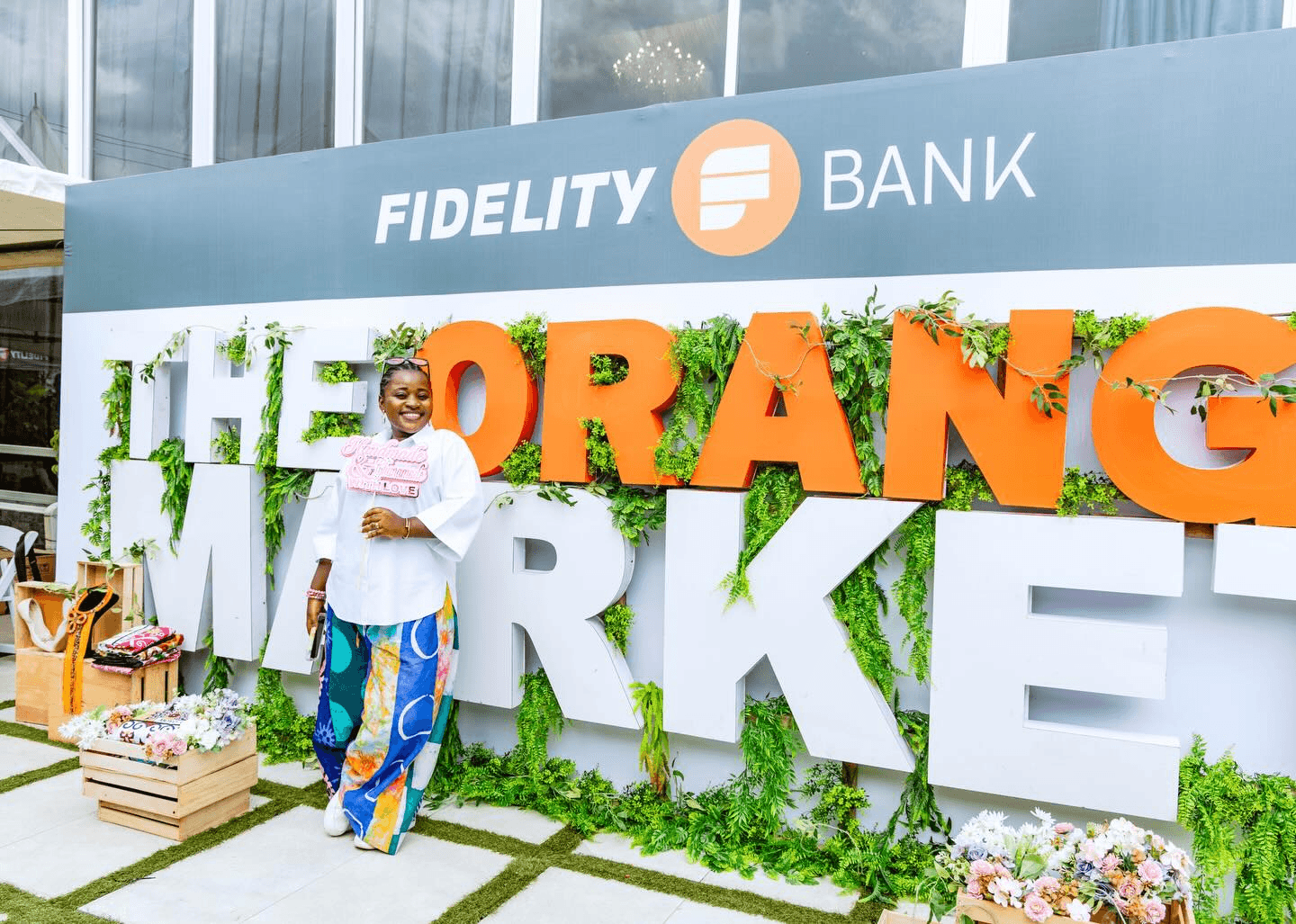
Fidelity provided the banking-side sponsorship; TAGM provided the curation, the operational event delivery, and the merchant relationships. The Orange Market is the clearest working template for what a TAGM commercial product looks like right now: a paid (sponsor-funded) event platform with curated merchant selection and a specific cohort focus.
That is what exists. The pivot is about what comes next.
The Retail-as-a-Service framing the company used in its announcement is borrowed from a specific category of retail-tech infrastructure that has emerged in the United States and Europe over the past decade. RaaS platforms in those markets typically sit between physical retail locations and small brands that want to sell through them.
The platform handles POS hardware, inventory management, payment processing, customer analytics, and increasingly working capital advances against platform transaction history. Leap, Neighborhood Goods, and b8ta are the US anchor cases. None of them has built a fully working version of the complete stack at meaningful scale; the category has been harder to execute than its thesis deck implies.
The African adaptation of the RaaS model looks different for structural reasons. The retail real estate stock is organised differently; mall density is lower; informal markets sit alongside formal retail in ways that would not map cleanly onto a Neighborhood Goods template.
A Ghanaian RaaS operator building for the creative economy would need to solve for the specific friction points that hold the country's small consumer brands back: limited high-footfall physical retail access, under-banked merchant relationships with the formal financial system, fragmented payment processor integration, and thin tools for inventory tracking and demand forecasting.
TAGM's own framing in the announcement names each of these friction points and positions the company's evolution as a direct response to them.
The distance between naming the problem and solving it is the part that needs interrogation.
Engineering. A fintech-enabled Retail Operating System is a software product. TAGM has not, as of this week, published engineering hires, a CTO appointment, or a technical architecture decision that would signal the company is building the software itself. The alternative paths are two.
The first is acquiring or partnering with an existing Ghanaian technology platform that already has the merchant-facing software TAGM would need.
The second is operating as a curated commercial layer on top of infrastructure built by someone else, with TAGM's brand providing the merchant relationships and customer trust while the back-end runs on a third-party SaaS stack. Both are legitimate approaches. Which one TAGM is actually taking will determine how much of the RaaS narrative the company genuinely owns.
Payment processing. The announcement frames payment processing as the backbone of the platform and names Visa as a partner. Visa is a card network, not a payment processor.
In Ghana, the processor layer is dominated by a smaller set of players: MobileMoney Limited (MTN's spun-out fintech arm), Hubtel, ExpressPay, IT Consortium, GhIPSS on the interbank side, and Ecobank's internal processing capability for its own merchants. A working RaaS platform for the creative economy would need to integrate with the processors its merchants' customers actually use, which in Ghana means a mobile money first integration followed by card and QR code.
TAGM's announcement gestures at mobile money, cards, and QR codes as payment methods the platform will support, but it does not name the processor relationships that would have to be in place for those methods to clear real transactions. The processor question is not optional. It is the feature that decides whether the platform is a functioning retail rail or a demo.
Working capital. The announcement also references "access to vital working capital" as part of the merchant value proposition, and elsewhere describes the platform as a way for small businesses to build transaction histories that improve creditworthiness and access to loans. This is the standard African fintech pitch and it is the pitch every SME credit operator on the continent is running.
The question, as always, is who actually writes the loan. TAGM is not a bank. None of the four commercial banks on the partnership list has publicly committed to underwriting credit against TAGM's platform data. The GIP platform's $20 million Norfund and Axis Pension commitment earlier this week is the template for how a domestic institutional capital channel can commit to SME financing at scale — but GIP is a standalone investment platform with its own underwriting infrastructure.
TAGM would need something structurally similar, or a partner bank willing to treat platform transaction data as a credit input, before its working capital promise becomes a working product.
The 90 percent women-led positioning. This is the distinctive competitive advantage. Female-led SMEs in Ghana are systematically under-banked relative to their contribution to the economy, and a platform that has eleven years of genuine relationships inside that cohort has access to a merchant pool that the formal banking system has struggled to reach.
Any RaaS play TAGM builds starts with a distribution advantage no other Ghanaian retail-tech operator currently holds. If the company executes on the pivot, the women-led composition of its merchant base is the moat. If it does not execute, the composition is still a real social impact story but not a sustainable competitive position.
The editorial question that the announcement does not answer, and that Ferviddy would ask Makafui Ayimey directly in an Operators interview, is the one about sequencing. Which comes first: the engineering team, the processor integrations, the bank credit partnership, or the commercial rollout to the merchant base?
The answer determines whether TAGM's 2026 is spent building the thing the announcement describes, or running existing pop-up events under a new brand narrative while the platform ambitions accumulate in a future tense that does not progress.
There is a plausible version of the pivot that works where TAGM builds or partners for the software layer, lands one processor integration, runs a credit pilot with one of the four partner banks using platform transaction data as the underwriting input, and converts the Orange Market model into a recurring monthly rhythm at one or two permanent physical locations.
Each of those moves is operationally legible, and each would be visible in the public record within six to twelve months of execution. The partnerships already in place are sufficient to make the sequencing work. What the announcement does not yet tell the market is whether the internal execution capacity matches the external positioning.
There is also a version where the pivot is primarily a fundraising narrative. A RaaS platform is a venture-backable category in ways that a curated pop-up event business is not. The announcement reads like an investor-deck narrative as much as it reads like a product announcement. That is not a disqualifying observation — most serious company pivots start with a narrative that precedes the product build because the narrative is what raises the capital that funds the build.
But the narrative-led pivot only becomes a real company pivot when the capital arrives and the engineering begins and neither of those has been publicly disclosed yet.
The better reason to pay attention to TAGM's announcement is the underlying insight about Ghana's creative economy. The country has an unmistakable concentration of small consumer brands, many of them run by women, operating across fashion, beauty, food, and art, with genuine product quality and an addressable customer base that has been chronically under-served by formal retail infrastructure. The gap between those brands and the infrastructure they need to scale is real.
Whatever solves it will be a meaningful company. TAGM has the distribution advantage and the merchant relationships. Whether it has the engineering and capital discipline to convert those advantages into a working platform is the question the next twelve months will answer.
What to watch: the first named CTO or technical lead hire at TAGM, the first publicly announced payment processor integration, the first credit pilot with any of the four partner banks using platform data, the first permanent physical retail location beyond the pop-up format, and the first external funding round that would let Ayimey's team actually build the platform the announcement described.