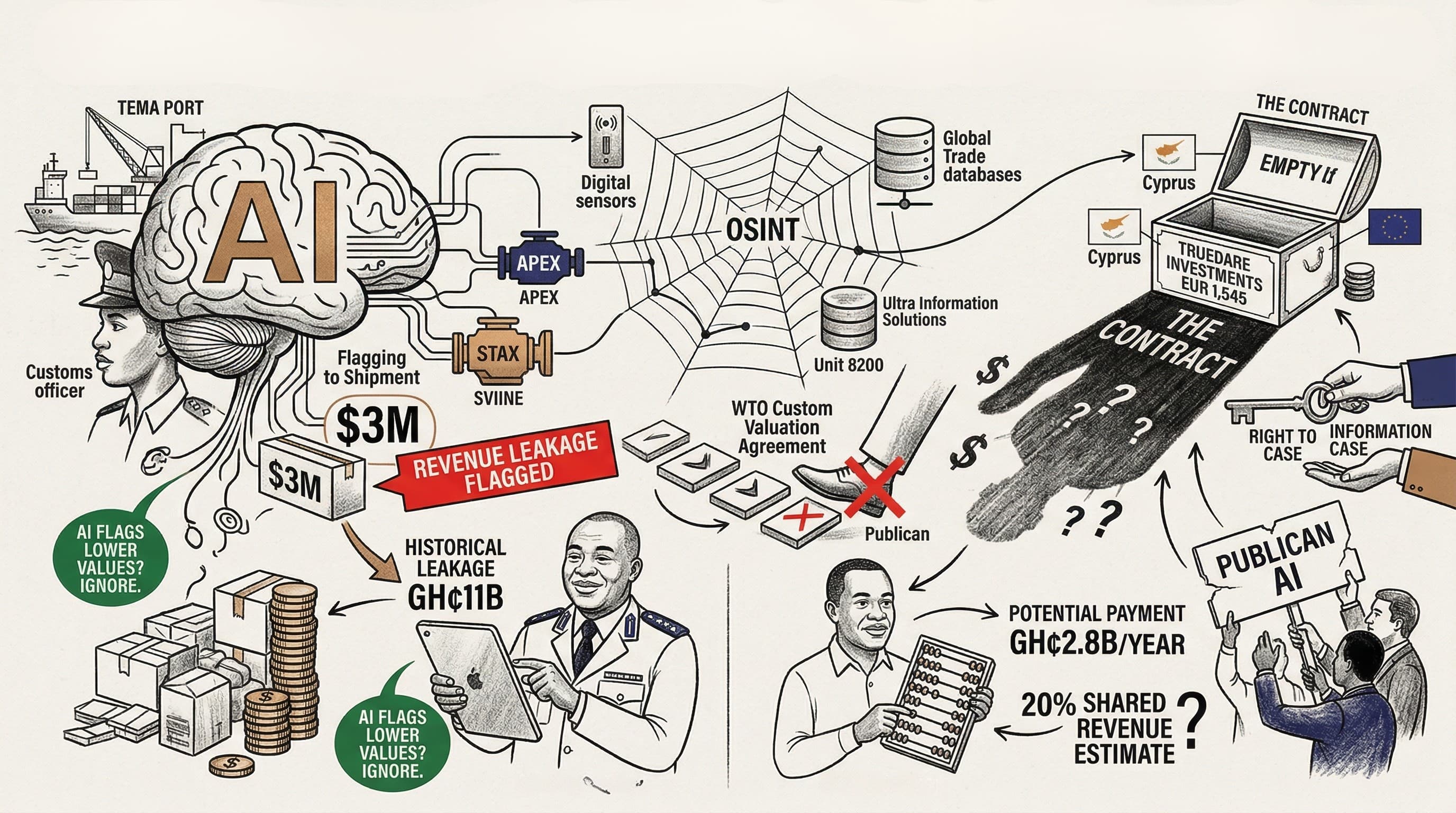

The Publican Trade Solution is an AI-powered customs risk assessment system that has been processing import declarations at Tema Port since 11 March 2026.
GRA Commissioner-General Anthony Sarpong says it has flagged GH¢11 billion in historical revenue leakage and identified $31 billion in transfers with no matching imports. A coalition of freight forwarders, traders, and customs brokers wants it suspended.
The Importers and Exporters Association of Ghana now backs it. Parliament approved the contract in November 2025 but the full terms have not been disclosed. A High Court case is seeking to force disclosure.
This is what the system actually is, who built it, and why the contract structure matters as much as the technology.
The technology: two engines, ten seconds per shipment
Publican runs on two proprietary engines developed by Ultra Information Solutions, an Israeli company headquartered in Herzliya.
The first, called APEX, is the data collection layer. It deploys what Ultra describes as thousands of digital sensors to retrieve information on people, goods, and companies from global trade databases, customs records, and open-source intelligence. It collects, sorts through proprietary algorithms, and correlates findings with internal datasets.
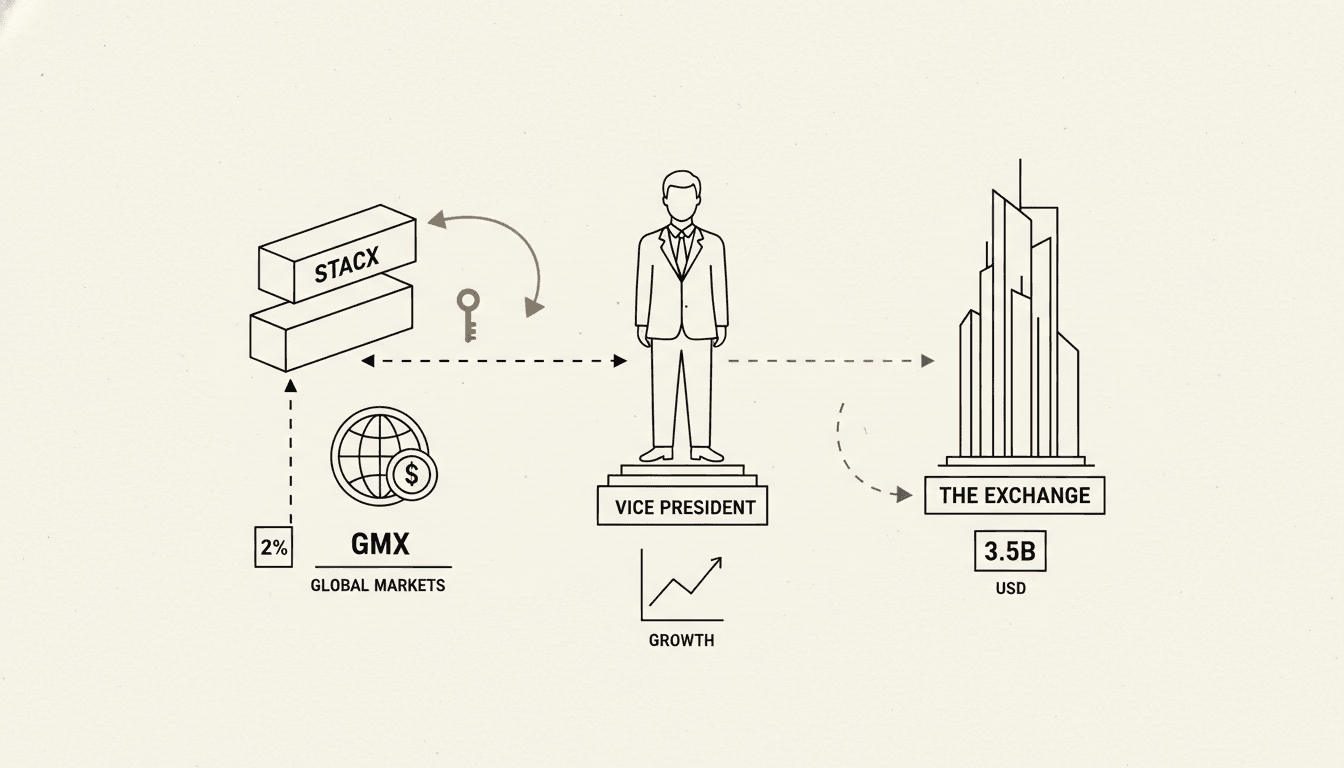
The second, STAX, is the analysis layer. It processes the output from APEX using deep learning models to construct standardised shipment profiles. Each new shipment is compared against these profiles and scored. The system returns a red, yellow, or green indicator to the customs officer and recommends a specific action: sampling, lab testing, receipt verification, catalogue review, or X-ray inspection.
Ultra says each shipment is screened in slightly less than ten seconds. At Tema Port, the GRA reports that full declaration processing now takes approximately five minutes, down from two hours under the previous manual process. In a February proof of concept reviewing over 6,000 declarations, the system flagged $3 million to $3.5 million per day in potential undervaluation revenue.
75.3% of declarations pass without dispute. 24.7% are flagged. Sarpong has said the system does not determine final values. It flags anomalies. The customs officer retains the decision.
Who built it: Ultra Information Solutions
The technology was not built by Truedare Investments Limited, the Cyprus-registered entity that holds the GRA contract. It was built by Ultra Information Solutions, founded in Herzliya in February 2016 by five entrepreneurs from Israel's security and intelligence sector.

CEO Ram Ben Tzion has over 20 years in intelligence, technology, and international transactions. Co-founder and COO Elad Kotzer is a former signal traffic analysis officer in Unit 8200, the Israeli military intelligence unit known for producing the founders of NSO Group, Check Point, and Waze.
He holds a PhD in Cognitive Science from Tel Aviv University. CTO Ben Gold served in the intelligence corps and holds a master's in molecular biology.
Ultra started in open-source intelligence, building tools to link digital identities to real identities for government clients, law enforcement, and airport security. In 2019, a meeting with venture capitalist Yaron Ashkenazi, a former Shin Bet officer who had led security details for Prime Ministers Rabin and Peres, redirected the company toward international trade compliance. Ashkenazi's firm, Awz Ventures, has since invested tens of millions of dollars across multiple rounds.
Ultra claims the Publican system operates in more than 40 government agencies worldwide. No specific deployment beyond Ghana has been publicly named. The company employs slightly over 70 people, generates tens of millions in annual revenue, is profitable, and is targeting $100 million to $120 million in annual recurring revenue.
The contracting vehicle: Truedare Investments Limited
Parliament approved the agreement between GRA and Truedare Investments Limited on 18 November 2025.
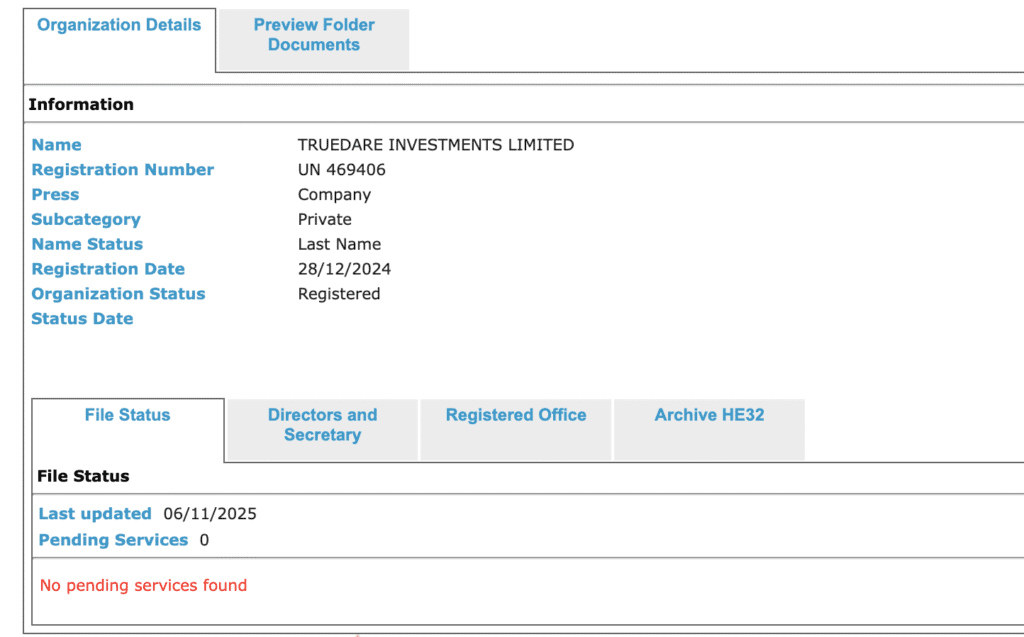
Truedare was incorporated in Cyprus on 28 December 2024, approximately eleven months before the parliamentary approval. Its registered share capital is EUR 1,545. Its declared business object is general trade. Its directors are Kyproulla Nikolaidou and Iliada Filaretou, two Cyprus-based individuals. Its company secretary is Aspire Secretarial Ltd. Two EU-based individual shareholders hold all shares. No registered charges or mortgages.
The formal relationship between Truedare and Ultra is not documented in any public filing, press statement, or parliamentary record. MP Michael Okyere Baafi described the company as Israeli-owned and registered in Cyprus.
No public evidence links Truedare to prior customs technology deployments, AI development, or trade systems of any kind.
Isaac Adongo, Chairman of Parliament's Finance Committee, told the House that the system would complement the existing ICUMS and that implementation would come at no additional cost to the state.
What that means in practice has not been disclosed.
What the critics found: the memo
The most consequential disclosure came from the Ghana Institute of Freight Forwarders. GIFF General Secretary Paul Kobina Mensah revealed that an internal GRA memo instructs customs officers not to accept AI-generated values if they fall below expected benchmarks. Officers must apply whichever value is higher.
That instruction means the system can only ever increase declared values, never decrease them. It functions as a de facto minimum valuation floor, regardless of what the importer actually paid.
Lawyer and tax policy analyst Francis Timore Boi wrote that this contradicts the WTO Agreement on Customs Valuation, which mandates that customs value must derive from the price actually paid or payable. The WTO framework establishes a sequential hierarchy of alternative methods specifically to prevent arbitrary minimum pricing. Boi's central question: are we using AI to validate transaction values, or to replace them?
Mensah also argued that the directive contradicts Sections 67 and 68 of the Customs Act 2015, which establish transaction value as the primary method and require a sequential approach before alternatives can be applied.
The existing system it sits alongside
ICUMS, the Integrated Customs Management System, launched in June 2020 as Ghana's single-window customs platform. It was built by Ghana Link Network Services in collaboration with CUPIA, the Korean Customs Service's technology arm. ICUMS replaced the older GCNet and West Blue Consulting systems and handles manifests, declarations, valuation workflows, risk channelling, inspections, duty collection, and post-clearance audits.
The Investment Times reported in January 2026 that the functions Publican was advertising already exist or could be natively configured within ICUMS. Critics warned that bolting an external AI platform onto a single-window system creates split workflows and undermines the reform principle the single window was built to deliver.
The GRA describes Publican as interfacing with both ICUMS and global customs data. The specific integration architecture has not been disclosed.
The revenue question
Former MP Joseph Cudjoe has produced the most detailed public estimate of the financial implications. Ghana's Customs Division generates approximately GH¢31 billion per year. If Publican delivers the 40 to 45 percent revenue increase the GRA projects, that is an additional GH¢14 billion annually. If the private entity receives 20 percent of incremental revenue, the payment could reach GH¢2.8 billion per year, or GH¢14 billion to GH¢28 billion over a five- to ten-year contract term.
Cudjoe's 20 percent figure is an estimate, not a confirmed contract term. The actual revenue-sharing model, the contract duration, and the payment mechanism have not been disclosed publicly. The Traders Advocacy Group Ghana sued the GRA under the Right to Information Act on 25 February 2026, seeking access to the full contract. GRA denied the request, citing protection of confidential third-party commercial information. The case was scheduled for hearing on 26 March at the High Court in Accra. The outcome has not been publicly reported.
The comparable: Webb Fontaine
The closest international comparison is Webb Fontaine, which operates AI-driven customs systems across Nigeria, Ivory Coast, Guinea, Congo, Benin, and Central Africa. Webb Fontaine replaced the UN-backed ASYCUDA system in Benin and is now building on large language models for what it calls agentic customs AI.
Ultra's approach is different. Publican is OSINT-based, using intelligence-grade data collection and deep learning fraud pattern detection rather than LLM-driven workflow automation. Both represent different AI architectures applied to the same customs modernisation challenge, and both are competing for the same set of African government clients.
What to watch
The system appears to be producing results at Tema. The revenue figures are real. The processing speed improvement is measurable. The IEAG's pivot from critic to supporter, after months of opposition, suggests the operational concerns were addressable.
But the contract transparency question has not been resolved. The relationship between Truedare and Ultra is undocumented publicly. The internal memo directing officers to only apply higher values undermines the system's credibility as a neutral risk tool. The Right to Information case could force disclosure. And the WTO valuation question, once raised, does not go away by being ignored.
The technology works. Whether the deal behind it is sound is a yet to be understood by even the parliamentarians with actual oversight.