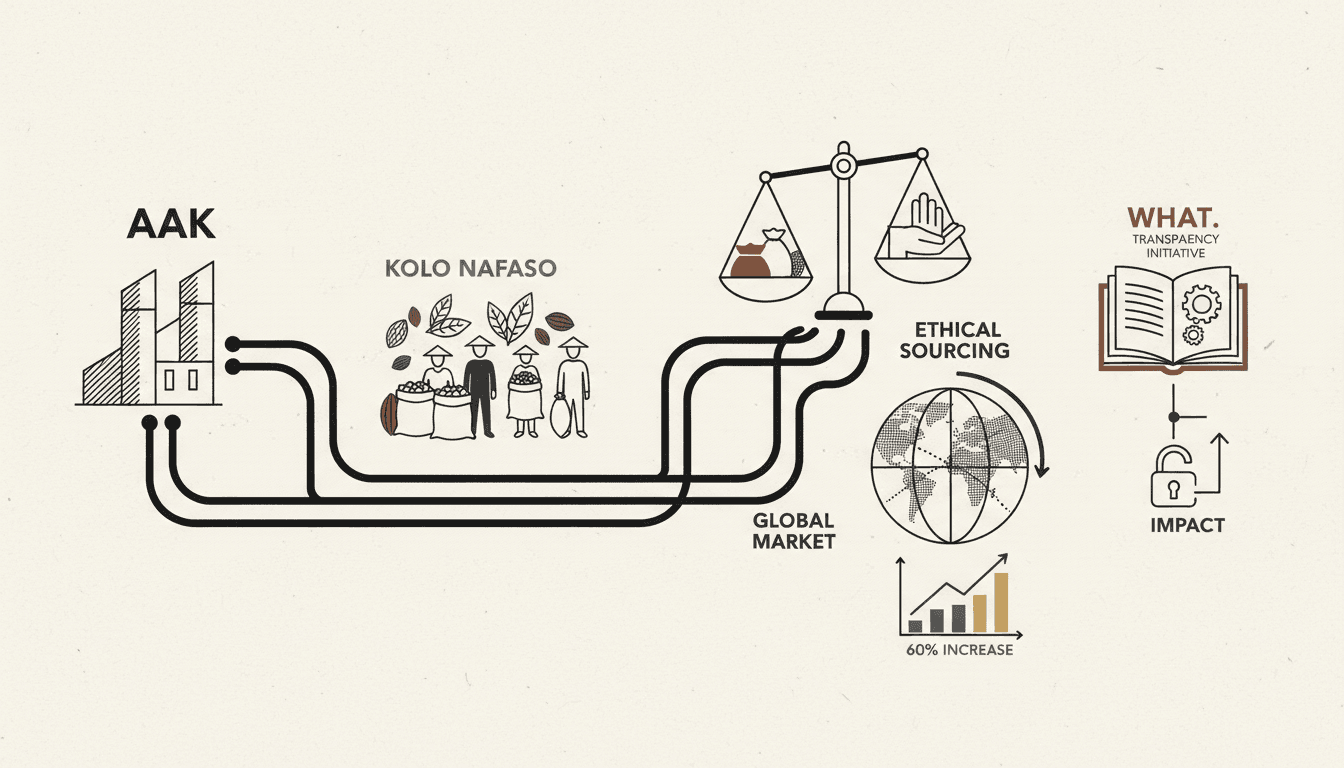
There is a Swedish company called AAK. For seventeen years it has been buying shea kernels directly from women in villages across West Africa. Burkina Faso since 2009. Ghana and Côte d'Ivoire since 2015. Nigeria came later. More than 320,000 women are inside the programme today, which is called Kolo Nafaso — "the house of benefits of shea kernels" in Dioula.
The scale is impressive enough. What I keep thinking about is how they got there.
For generations, a woman in a shea village in northern Ghana or southern Burkina had a supply chain that was designed without her in mind. She harvested the nuts. She sold them to a travelling middleman who came to the village when he wanted to, at a price he named. The middleman passed them to another trader, who passed them to an exporter, who eventually sold to someone making chocolate or cosmetics in Europe or the US.
Each step took a cut. By the time the kernels left the port, the woman who had picked them was usually holding a small fraction of what the international market was paying.
AAK decided in 2009 to do it differently. They went around the middlemen. They organised women into village-level groups and bought kernels directly. They advanced the women money ahead of each harvest, so there was working capital in the village before the nuts had even come off the tree. They put collection points in the villages themselves, so the weighing and grading and payment all happened where the women lived and not at the end of a six-hour walk. They trained the groups on post-harvest handling, because the thing that determines whether shea sells for a good price or a bad one is how the kernel is dried and cleaned.
All of that sounds straightforward. Here's the part that actually mattered, and honestly it took me a while to see it.
The money AAK advances to the women before harvest is not tied to an exclusive supply contract. A woman who takes the pre-financing can still sell her kernels to someone else if that someone else shows up with a better price. That does not happen in most agricultural value chains. A buyer who advances capital wants exclusivity. The exclusivity is what protects the buyer's position.
AAK decided the relationship with the women was worth more than the exclusivity. They gave it up. They accepted that some women would take the cash and sell elsewhere. In exchange they got a programme that 320,000 women willingly participate in. The trust they bought was larger than the extraction they gave up.
The collection points are the other thing worth sitting with. Before they existed, a woman in a village six hours from the nearest real marketplace had three bad choices. Walk the nuts out herself and lose a day to the round trip. Sell to whichever middleman happened to come that week, at whatever price he decided she couldn't refuse. Or watch the kernels deteriorate in storage until they were worth even less.