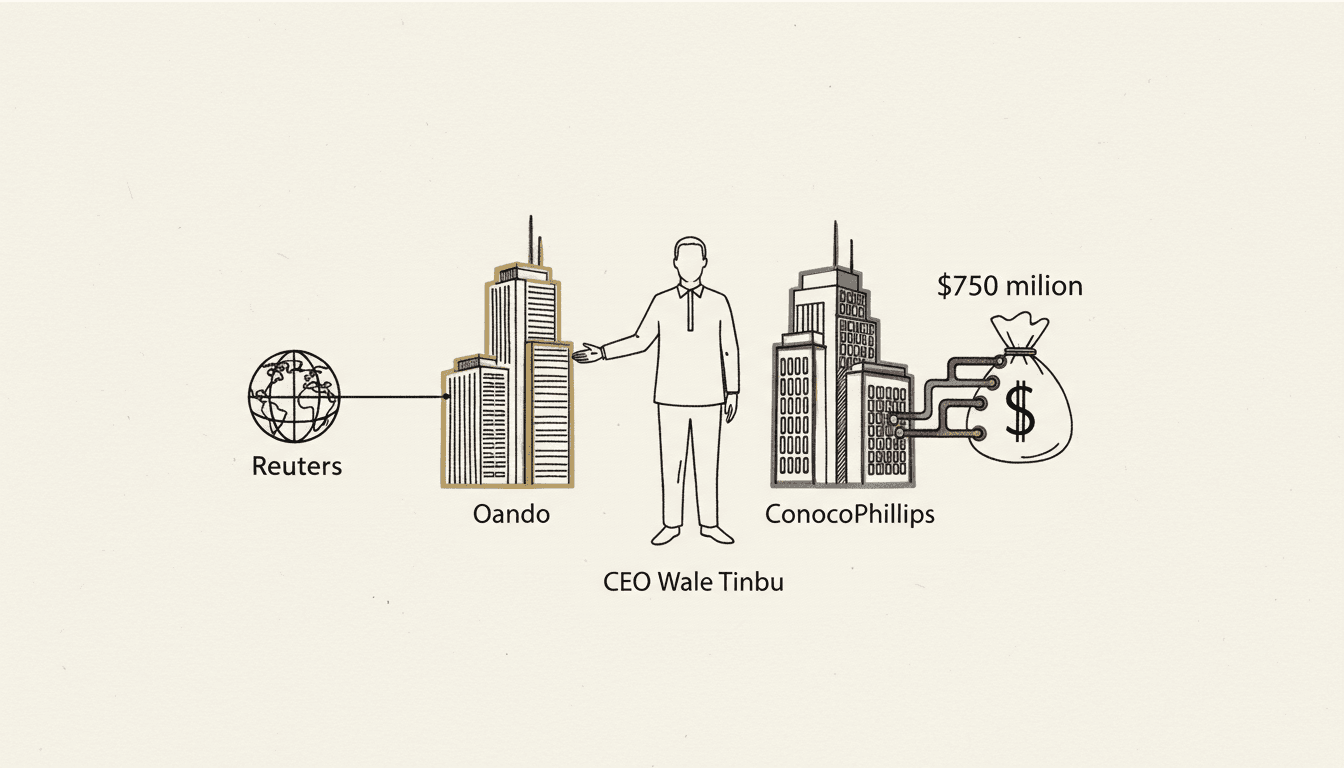
Oando is raising up to $750 million in 2026 for a 100-well drilling campaign that CEO Wale Tinubu says could triple the company's oil output, he told Reuters on 10 April. Current production averages 32,000 barrels of oil equivalent per day. A threefold increase would push it toward 128,000 boepd, ahead of the 100,000 bpd target the company had set for 2029.
The raise sits inside a larger $1.5 billion multi-instrument programme the board approved in August 2025. The wells will target fields acquired in two transactions: the $1.5 billion ConocoPhillips Nigeria purchase in 2014 and the $783 million acquisition of Eni's Nigerian Agip Oil Company in August 2024. Together, those deals gave Oando a 40 percent stake in OMLs 60 through 63, encompassing 40 discovered oil and gas fields of which 24 are currently producing.
The infrastructure bottleneck does not exist. Oando operates 1,490 kilometres of pipelines, three gas processing plants, and handling capacity of 483,000 barrels of oil per day. The company is producing at roughly 7 percent of its infrastructure capacity. The constraint is drilled wells, not surface facilities. That is what makes the 100-well campaign a production multiplier rather than a greenfield build.
The funding shift
Tinubu said the Gulf crisis has shifted investor appetite. European banks that funded the company's earlier growth have withdrawn from African hydrocarbons over ESG concerns. The replacement capital is coming from African development finance institutions — Afreximbank arranged the $650 million facility for the NAOC acquisition — commodity trading houses including Vitol, Trafigura, Glencore, and Mercuria, Gulf banks, and private equity.
Brent crude surged past $120 per barrel after Iran closed the Strait of Hormuz on 4 March. With Gulf oil supply disrupted by more than 90 percent, Nigerian crude is repriced as a safe alternative. Tinubu told Reuters that Africa is now seen as peaceful compared to the producing regions in conflict, and that this perception shift is opening funding sources that were previously closed.
The reserves base
Following the NAOC acquisition, Oando's 2P reserves nearly doubled from 505 million barrels of oil equivalent in 2023 to 983 million in 2024. In March 2026, the company signed a production sharing contract for Block KON-13 in Angola's onshore Kwanza Basin, its first operated international upstream joint venture, with estimated resources of 770 million to 1.1 billion barrels gross. Tinubu also said the company is exploring opportunities in Ghana and Ivory Coast.
The West Africa signal
The story for the region is the funding pattern. International oil companies are exiting West African assets. Local companies are acquiring them at discounts. And the capital to develop those assets is being assembled from African institutions and commodity traders rather than from the London and New York banks that funded the previous generation of West African oil development. Oando is the most visible example, but the model applies across the basin.