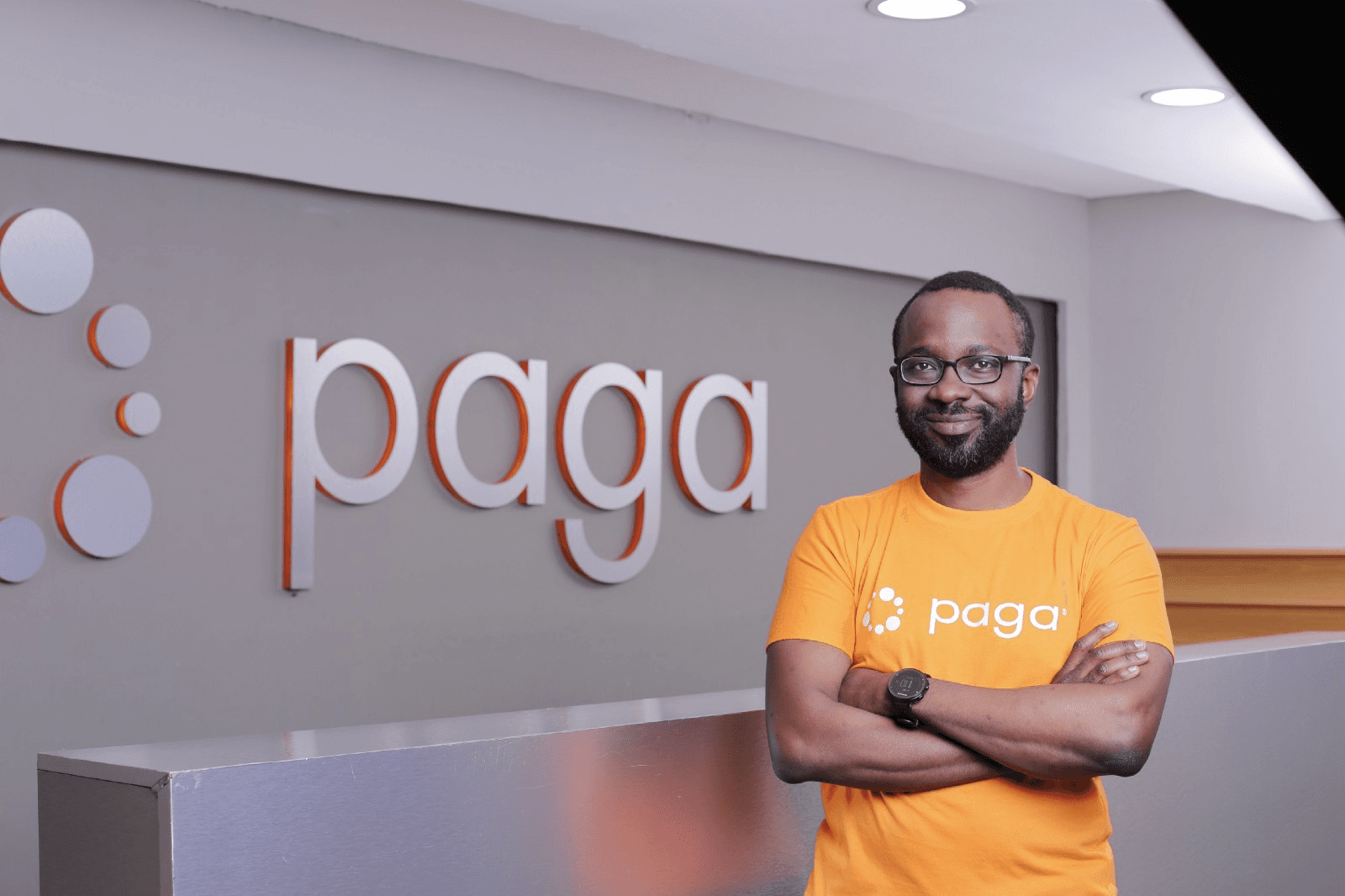

Paga's Nigeria operation, the company Tayo Oviosu founded in 2009, will be run by someone other than Oviosu for the first time in its 17-year history.
The new CEO is Opeyemi Oyinloye, a long-time Paga executive whose appointment is subject to approval from the Central Bank of Nigeria. Oviosu moves to a Group CEO role with explicit responsibility for international expansion and the company's pan-African and diaspora strategy. Co-founder Jay Alabraba transitions to a special projects and market expansion role inside the same restructure.
The reason it matters is the scale Paga reached before the transition was triggered. Paga processed ₦17.1 trillion ($12 billion) in transaction value in 2025, a 96 percent year-on-year jump.
The company launched US banking services for the African diaspora in September 2025 through a partnership with Regent Bank, and in January 2026 became PayPal's local partner in Nigeria. Those are the pieces of a company that has outgrown the geographic constraints of being a single-country mobile money operator and that is now trying to be something else.
Oviosu's framing of the transition, in his own words: about a year ago, "it became very clear to me that for us to accelerate, we need someone else to come and run the day-to-day of the business lines." That is the cleanest version of a sentence founders rarely manage to say.
Most founders confuse the work of running an operating business at scale with the work of starting one, and most do not separate the two until the operating business has either stopped growing or has lost so much institutional knowledge to executive churn that the founder is the only person left who remembers how the company was supposed to work. Oviosu is making the move while the operating business is still growing fast.
Three things follow.
The first is what the Group CEO role actually looks like in practice. The pre-2026 Paga strategy included aspirations to enter markets like Mexico and the Philippines as part of a broader diaspora-finance thesis. The 2026 strategy has narrowed that to Africa and the African diaspora, which is a more disciplined geographic frame. Inside that frame, Oviosu has the Regent Bank partnership as the US anchor and the PayPal partnership as the Nigerian volume layer.
The Group CEO mandate is to take those two anchors and build the connective tissue between them: a Ghanaian-American sending money to a Lagos relative, an Accra-based freelancer invoicing a Manchester client, the cross-border use cases that the company's existing infrastructure can support if the regulatory and licensing work is done in the right markets in the right order.
The second is what Oyinloye inherits. Paga Nigeria is the engine. The 2025 transaction value number of $12 billion is roughly twice what it was in 2024. The user base, the agent network, and the operating infrastructure are all at scale. The challenge for a new CEO is not turning the engine over; it is preventing the inevitable founder-departure-syndrome where senior executives who joined to work for Oviosu directly start asking themselves whether they want to keep working at a company that is no longer run by him.
Oyinloye is an internal hire, which mitigates that risk and the CBN approval is just now procedural step to confirm it.
The third is the comparator question for Ghana. Paga is the closest analog to the kind of mobile money operator that has built scale through agent networks and bank partnerships rather than through a sponsoring telecom. The country's nearest equivalent is the standalone fintech segment that has emerged outside of MTN MoMo's structural dominance: Hubtel, Zeepay, ExpressPay, Fido on the consumer credit side, and a handful of others. None of them has reached Paga's scale, maybe save Hubtel.
The reasons are partly about market size, partly about the fact that the country's mobile money infrastructure is dominated by a single telecom-affiliated player whose recent separation into a standalone fintech entity only formalised what was already a structural moat. Whatever the reasons, the Paga transition is the first in a series of founder-to-operator handoffs the African mobile money sector is going to see across the next several years. How Paga executes the transition will be a working template for the others.
For Oviosu specifically, the move is an unusual one for a founder of his profile. Most African fintech founders who have built companies of Paga's scale either remain as CEO until the company is acquired, sell down their stakes and become passive investors, or leave to start something new. Stepping into a Group CEO role and explicitly handing day-to-day operational control to a successor is the rare middle path.
It works only if the successor has the autonomy to run the company on his own terms and if the founder has the discipline to stop reaching back into the operating business when he sees something he would have done differently. Oviosu's stated reason for the move suggests he understands both halves of that requirement. Whether the structure holds in practice is the question the next 18 months will answer.
The strategic narrative the move sets up (Africa, diaspora, AI, crypto, cross-border payments) is the kind of narrative every African fintech of similar scale is now telling. Paga has the advantage of an operating engine that is already throwing off the cash flows the strategy needs. It also has the advantage of a founder who can credibly carry the strategy in the rooms where it has to be sold to international partners and capital providers, while a separate operator runs the engine that is funding the strategy.
That separation is what makes the transition more interesting than the average founder-CEO change.